
Chapter 26: Governing the Governance Function
The ACG was introduced in Chapter 13 as the organizational body that makes authorization decisions before executors enter the execution surface. Chapters 17 through 21 defined the four decision types the ACG processes, the latency standards it is held to, and the documentation it maintains. The ACG is, in this document's model, the central governance institution for the hybrid organization's execution surface.
The governance model is complete only if the body that governs it is itself governed.
One question has not been asked: who governs the ACG?
The ACG makes consequential decisions. It authorizes executors for execution modes that determine how much autonomous authority those systems hold over business outcomes. An ACG that is functioning correctly provides a genuine governance layer — substantive review, genuine independence, real competence. An ACG that has degraded produces something that looks like governance from the outside and is not. The authority grant records are filed. The reviews are completed. The quarterly summaries are produced. And the authorization decisions are inadequate — too permissive, too deferential, too uniform — in ways that no downstream governance mechanism will catch because those mechanisms assume the authorization was sound.
The governance of the ACG is the CTO's direct responsibility, because its decisions are made in the CTO's authority. Not as a bureaucratic oversight layer, but as the structural question that closes the governance model: are the decisions made in my name by the body I established actually reliable? This chapter addresses how to answer that question.
THE CORE IDEA
All existing governance instruments measure activity. None of them measure decision quality. The decision latency register catches slow decisions. The quarterly governance session catches absent decisions. The authority grant records confirm decisions were made. None catches whether the decisions were good.
Review quality degradation. Reviews are completed, but the decisions do not constrain behavior. The scope boundaries are vague — generic statements that do not constrain the executor's authority in any meaningful way. The monitoring model is accepted without validation against the executor's actual failure modes. The consequence tier is assigned without documented rationale. The authorization rate is near one hundred percent with no deferrals in recent memory. Each review, taken individually, is formally complete. In aggregate, the ACG has become a stamp rather than a filter. The consequence tier is only meaningful if the ACG understands what failure at that tier actually means in practice — a T1 tier assigned without understanding the executor's failure modes is not a governance decision. It is a label.
Independence erosion. Independence erosion does not appear as a violation. It appears as a pattern. The ACG's authorization decisions correlate with factors that should be irrelevant to governance fitness: the seniority of the deploying team, the visibility of the project, the proximity of a deadline. High-priority initiatives from senior teams receive authorizations with fewer conditions. Deliveries under deadline pressure receive scope boundaries that shrink from what the authority grant template specifies. The ACG lead does not formally escalate when overruled informally in a pre-review conversation. The authorization decisions are systematically biased toward approval, and the bias is structurally invisible in the records.
Competence gap. Competence does not fail suddenly. It becomes outdated. New classes of AI agents enter the surface — large language model-based systems, multi-agent architectures, generative systems with non-deterministic outputs. The ACG was sized and staffed for the executor types that existed when it was established. Its members understand the failure modes of rule-based automation and supervised ML models. They do not understand the failure modes of the new classes being deployed. Reviews are completed because the review process requires completion, not because the reviewer can meaningfully evaluate whether the monitoring model will catch the failure modes they have not been trained to identify.
Figure: Three ACG health dimensions — healthy signals, degraded signals, CTO measurement, and correction responses
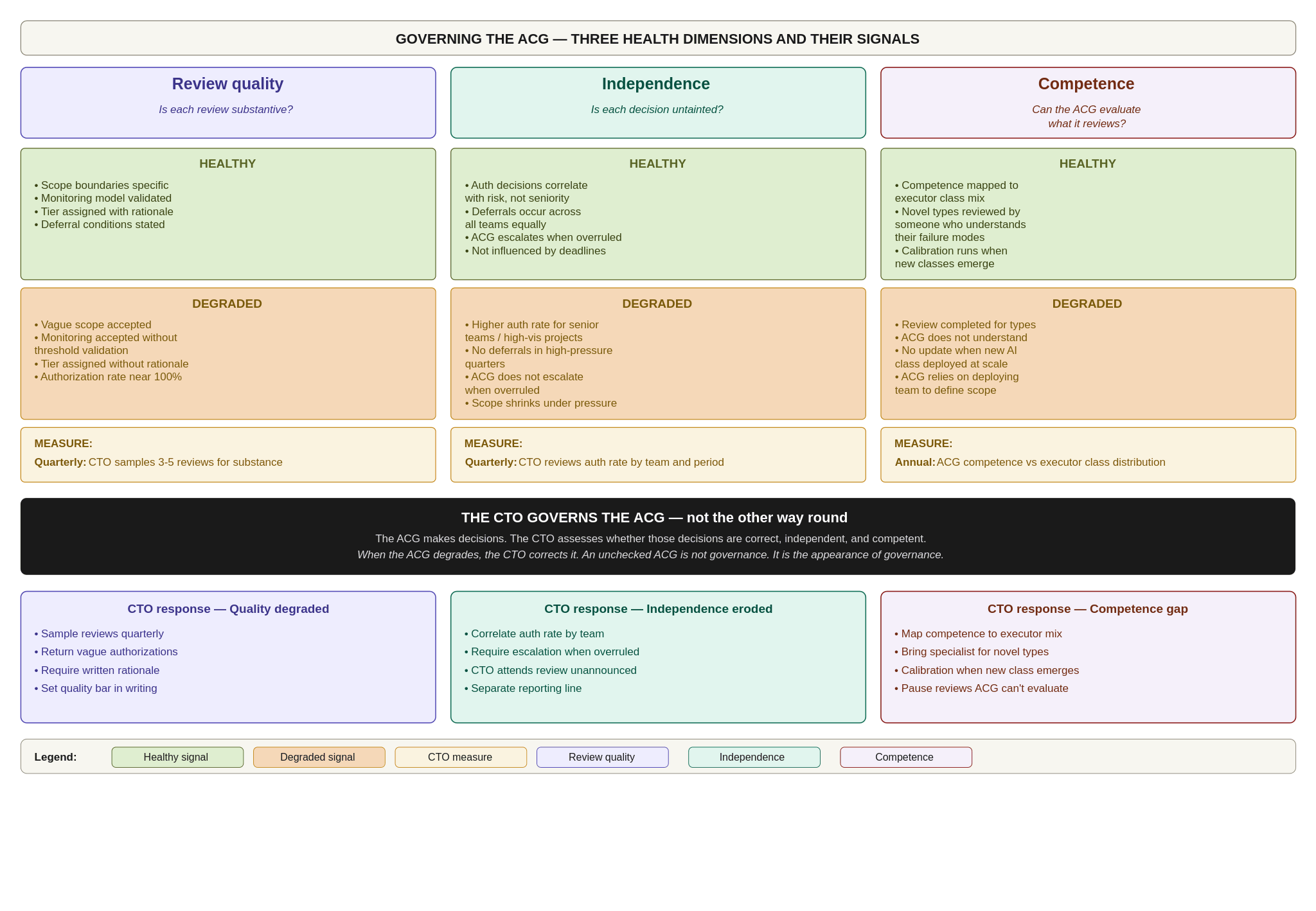
Three dimensions of ACG health: review quality (is each review substantive?), independence (is each decision untainted?), and competence (can the ACG evaluate what it reviews?). For each: healthy signals, degraded signals, how the CTO measures, and the correction response when degradation is detected.
REVIEW QUALITY: SUBSTANCE OVER PROCESS
The most difficult dimension of ACG health to assess is review quality, because the indicators of degradation are not in the process — they are in the content of the decisions. A process-level audit confirms that reviews were completed, fields were populated, and records were filed. A quality audit asks whether the content of those fields is substantive.
The CTO assesses review quality through quarterly sampling: three to five authority grant records selected from the past quarter's reviews, examined for the specific content quality indicators that distinguish substantive review from form-filling. Four indicators matter.
Scope boundary specificity. A scope boundary that reads 'applications outside the model's training distribution' is not a governance constraint — it is a technical description that provides no operational guidance to an escalation owner. A scope boundary that reads 'applications from employer categories not on the approved industry list, and any application where the applicant has filed a regulatory complaint in the past twenty-four months' is a governance constraint. The CTO looks for specificity: can an escalation owner apply this boundary in practice without further instruction?
Monitoring model validation. The authority grant record specifies a monitoring model. The quality question is whether that model was validated against the executor's actual failure modes — not whether it was copied from a prior record or accepted at face value from the deploying team. An ACG reviewer who understands the executor type should be able to identify at least one failure mode that the proposed monitoring model might miss, and either add a monitoring requirement or document why the failure mode is out of scope.
Tier assignment rationale. The consequence tier from Chapter 24 and Appendix H requires four consequence questions to be answered. The quality question is whether the tier assignment in the record is traceable to those questions. A tier of T2 with no rationale could mean the ACG worked through the four questions and reached T2. It could also mean T2 was assigned as a default. The distinction is not visible in the tier field alone — it is visible only if the rationale field is populated with a reference to the consequence question answers.
Authorization rate over time. A healthy ACG authorizes most submissions that have been properly prepared — because the intake routing rule from Chapter 23 means submissions that arrive for ACG review have already passed a pre-review preparation step. But a healthy ACG also defers and conditionally approves a meaningful proportion of submissions, because governance fitness assessment is not a binary pass/fail for well-prepared submissions. An authorization rate that has been at or above ninety-five percent for three consecutive quarters, with zero unconditional deferrals, is a signal that the ACG's filter function has degraded.
INDEPENDENCE: THE HARDEST DIMENSION TO PROTECT
Independence is the most structurally vulnerable of the three dimensions because the pressures that erode it are normal organizational pressures — delivery timelines, senior relationships, visible projects, difficult conversations. No one decides to compromise the ACG's independence. The erosion happens incrementally, through individually reasonable accommodations that together produce a pattern of systematically biased decisions.
The CTO protects ACG independence through three structural mechanisms, not through exhortation.
Authorization rate stratification. Each quarter, the CTO reviews the ACG's authorization decisions stratified by deploying team seniority and by delivery pressure period. A healthy ACG shows no meaningful correlation between these factors and authorization outcomes — or where correlation exists, it is explained by the quality of the submission, not the status of the submitter. When the correlation cannot be explained by submission quality, independence has eroded and the finding is shared with the ACG lead explicitly.
Mandatory escalation documentation. When the ACG lead is overruled — formally or informally — the escalation is documented in the authority grant record as a condition of the authorization proceeding. The documentation records who overruled the ACG, on what grounds, and what governance risk the overrule introduced. This creates an organizational record that makes informal pressure visible and provides the CTO with a complete picture of cases where ACG independence was bypassed rather than exercised.
Structural separation. The ACG lead's reporting line should not run through the teams whose deployments the ACG reviews. In organizations where the ACG lead reports to an engineering VP whose teams are the primary submitters, the independence structure is compromised by design. This is not a personal failure of the ACG lead — it is an organizational design that makes independence structurally difficult. The correction is to align the ACG reporting line through the CTO directly, or through a governance function independent of the delivery teams.
COMPETENCE: KEEPING PACE WITH THE SURFACE
ACG competence is not a fixed state — it is a relationship between the ACG's current capability and the current state of the execution surface. An ACG that was competent to review the executor types present on the surface eighteen months ago may be materially less competent to review what is being deployed today. The competence gap opens not through any single failure but through the continuous evolution of the execution surface in the space between competence calibration events.
The CTO assesses ACG competence through an annual review of the ACG's capability profile against the executor class distribution on the surface. The question is not whether the ACG is generally competent — it is whether the ACG can specifically evaluate the failure modes of the executor types currently being deployed at scale. Three classes of executor currently produce the most common competence gaps.
Large language model-based executors. LLM-based systems have failure modes that differ materially from supervised ML models and rule-based automation: hallucination, prompt injection, context window limitations, inconsistent output quality across input types, and emergent behaviors under distribution shift. An ACG reviewer who can evaluate a supervised classification model's monitoring model may not be able to evaluate whether a proposed monitoring approach for an LLM-based executor will catch these specific failure modes.
Multi-agent architectures. When executors interact with other executors — one AI system calling another to complete a task — the governance model must account for the interaction effects, not just the individual executor's behavior. A monitoring model designed for a single executor does not catch failures that emerge from the combination. An ACG reviewer evaluating a multi-agent deployment needs to understand the failure modes of the architecture, not just the individual components.
Vendor execution dependencies with embedded AI. Third-party services with AI capabilities embedded in their outputs present a specific competence challenge: the ACG must evaluate governance fitness for a system whose internal workings are not available for inspection. The competence required is not technical — it is the ability to evaluate governance fitness through behavioral specifications, service level agreements, and contractual governance terms rather than through direct inspection of the system.
When the ACG identifies an executor type it cannot competently review, the correct response is not to complete the review anyway — it is to pause the review and bring in the competence required, whether through specialist input, external expertise, or a structured competence development process before the review proceeds. An incomplete review that acknowledges its limitation is more valuable to the governance model than a complete review that does not.
THE CTO ACTION REFERENCE
The three health dimensions require different assessment actions at different frequencies. The following reference maps each dimension to the specific action the CTO takes, how often, which instrument provides the data, what signal triggers an out-of-cadence intervention, and what the correction response is when degradation is detected.
Figure: CTO action reference — ACG health assessment by dimension
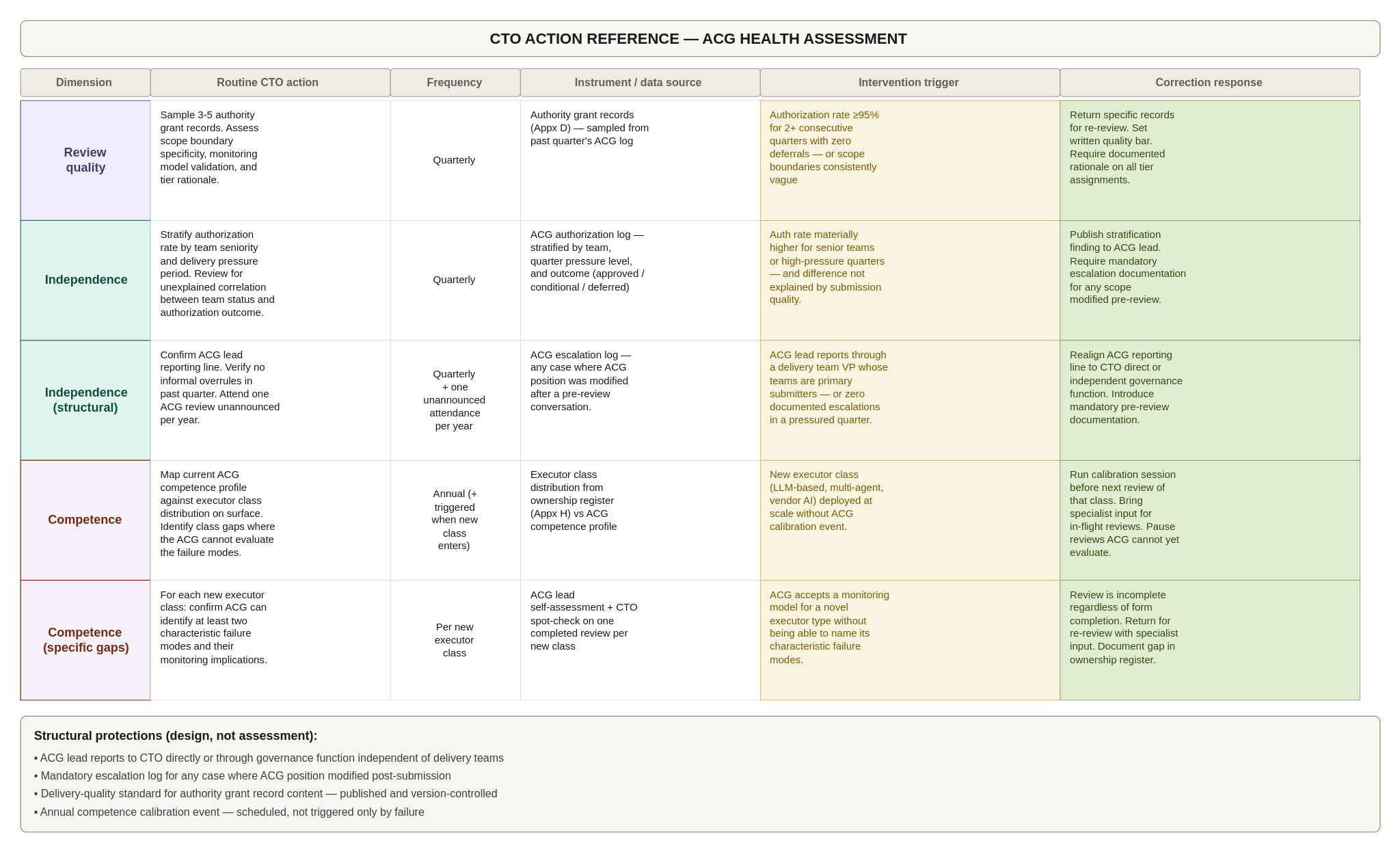
Five assessment actions across three health dimensions. Amber column: the signal that triggers an out-of-cadence intervention. Green column: the correction response when the trigger fires. Bottom row: structural protections that reduce the probability of degradation rather than detecting it after the fact.
Two observations from the reference are worth making explicit. First, the frequency distinction between review quality and independence (quarterly) and competence (annual plus triggered) reflects the different degradation timescales. Review quality and independence can erode within a quarter under sustained delivery pressure. Competence gaps open more slowly, as the surface evolves, but their consequences are harder to reverse — a year of reviews completed by an ACG that did not understand the executor class being reviewed is a year of authorizations that cannot be assumed to be sound.
Second, the structural protections at the bottom of the reference are design decisions, not assessment actions. They reduce the probability of degradation rather than catching it after the fact. An ACG whose reporting line runs through a delivery VP is structurally exposed to independence erosion regardless of how carefully the CTO assesses authorization rate stratification. The structural protection removes the exposure; the quarterly assessment detects whether residual exposure is producing bias. Both are required.
THE ACG REPORTING LINE: ORG CHART IMPLICATION
Chapter 13 established the ACG as a cross-functional governance body without specifying its reporting line. Chapter 26 closes that gap: the ACG lead reports directly to the CTO, not through an engineering or product VP whose teams are the ACG's primary submitters. The reporting line is the foundational structural protection for ACG independence. No quarterly assessment can fully compensate for a reporting structure that systematically exposes the ACG lead to pressure from the teams they review.
Figure: Technology organization at scale stage — ACG as direct report to CTO
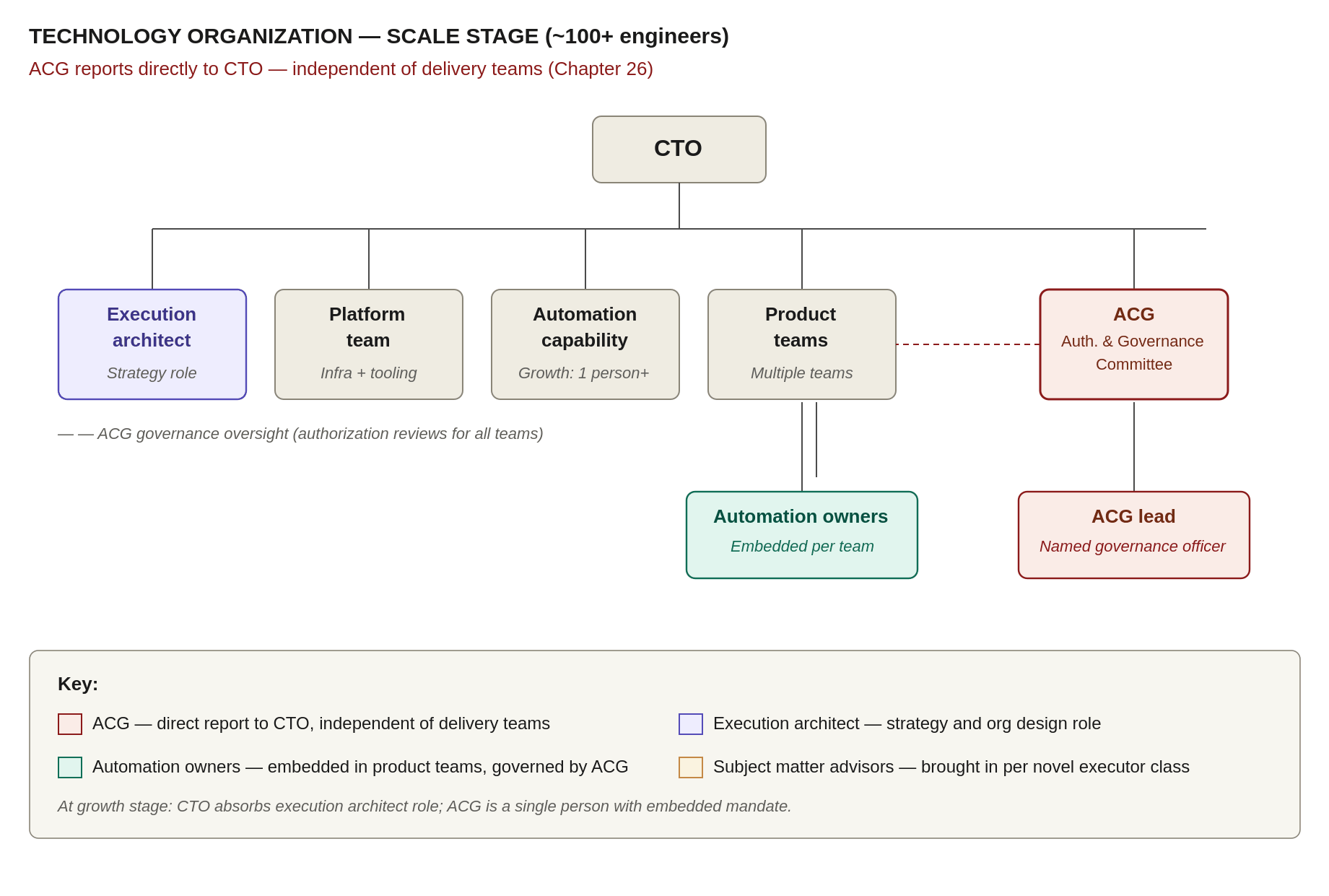
The ACG sits as a direct report to the CTO alongside the platform team, automation capability, and product teams — independent of all delivery teams. The dashed line shows the ACG's governance oversight relationship across all teams. The ACG lead, subject matter advisors, and governance library sit below the ACG node. Automation owners remain embedded in product teams but governed by ACG authorization requirements.
The failure mode is the organization that has an ACG, trusts the ACG, and has built a governance model on the assumption that ACG authorization decisions are sound. The authority grant records are filed. The reviews are completed on time. The quarterly summaries are produced. The board report references the ACG's review completion rate as evidence of governance health.
Inside that machinery, review quality has degraded to form-filling. Independence has eroded under fourteen months of accumulated informal pressure. Competence has not kept pace with the executor types now being deployed at scale. None of these failures appears in any governance metric the organization tracks, because all of those metrics measure ACG activity — completion rates, latency, record counts — not ACG quality, independence, or competence.
A CTO who has not assessed ACG health in three or more quarters does not know whether the governance model is functioning or performing. The quarterly sampling of review quality, the stratified authorization rate analysis, and the annual competence calibration are not bureaucratic additions to the governance model. They are the CTO's instrument for answering the question that no other instrument answers: is the body making decisions in my name making them correctly?