
Chapter 16: Designing for Role Clarity Under Ambiguity
The previous four chapters established the roles that hybrid execution requires. This chapter addresses the condition that persists even when all of those designs are in place: ambiguity. Not the ambiguity of missing roles — that is the problem the previous chapters solved. The ambiguity of overlapping roles, of boundaries that shift as the execution surface evolves, of situations that fall between the designed categories and require a decision about who acts.
In a hybrid organization, this kind of ambiguity is not a design failure. It is a structural condition. The execution surface changes faster than organizational design. New executor types emerge. Execution modes transition. AI capabilities expand into domains the ownership model was not originally designed to cover. The roles are newer and their boundaries less settled than the roles they sit alongside.
The question is not whether ambiguity will exist. It is whether the organization is designed to resolve it quickly and correctly — or whether it discovers the gap only when something fails.
THE CORE IDEA
Role clarity, in the context of hybrid execution, does not mean that every person knows every boundary of their accountability. It means that when something fails, when a decision needs to be made, or when an ownership question arises — there is a fast, unambiguous path to the right person, and that person has the mandate and the context to act.
Role clarity is therefore not a state to achieve. It is a property to design for — through four instruments that work together.
Explicit role assignments with declared scope. Every significant executor has named owners. Every ownership assignment includes the job description from Chapter 12 and the dual ownership designation from Chapter 15 where it applies. Every new role from Chapter 13 has a documented mandate, a declared scope, and a named person.
Boundary protocols for predictable overlap points. The boundaries that will be disputed are predictable. These boundary points do not resolve themselves. They require a designed protocol — a defined decision authority, a documented resolution process, and a timeframe.
A living ownership register and accountability map. The register and the map are not documentation artifacts. They are decision-support instruments. When ambiguity arises, the register and map are where the answer is found or the gap is made visible. They must be current to be useful.
An escalation path for unresolvable boundary disputes. Some boundary disputes cannot be resolved by the parties involved. These disputes require a defined escalation path — a named third party with the authority to make the decision and the context to make it well. Without this path, boundary disputes produce accountability stalls.
THE PREDICTABLE AMBIGUITY POINTS
Figure: The five ambiguity points — parties, resolution instrument, and escalation owner
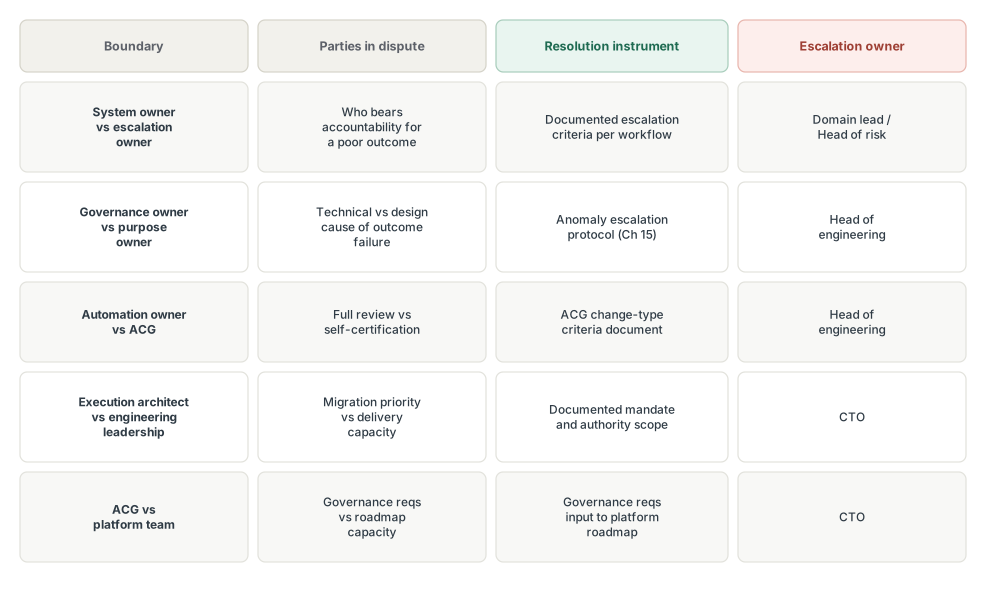
Each row names a predictable boundary dispute, the instrument that resolves it without escalation, and the named escalation owner when the instrument is insufficient. The resolution instrument must be documented before the dispute arises.
System owner versus escalation owner. The boundary dispute arises when the escalation produces a poor outcome: was the poor outcome the result of the system routing the wrong case (system governance failure) or the human making a poor decision on a correctly routed case (escalation decision failure)? The designed answer requires documentation of what constitutes a correctly formed escalation from this system — and what constitutes an acceptable escalation decision.
Governance owner versus purpose owner. The boundary dispute arises when outcomes deteriorate and the cause is ambiguous: is it behavioral drift the governance owner should have detected, or design misalignment the purpose owner should have identified? The designed answer is the anomaly escalation protocol from Chapter 15 — the trigger that moves the question from individual investigation to joint assessment before the attribution dispute arises.
Automation owner versus ACG. The boundary dispute arises when a deployment review is triggered and the automation owner believes it is excessive for the change in question: full review or self-certification? The designed answer is explicit change-type criteria in the ACG's governance library that removes the classification from judgment to documented rules.
Execution architect versus engineering leadership. The boundary dispute arises when a structural migration requires platform investment or team capacity that conflicts with current delivery priorities. The designed answer is a documented mandate for the execution architect that defines advisory versus required authority, with a clear and fast escalation path to the CTO.
ACG versus platform team. The boundary dispute arises when governance requires platform infrastructure — monitoring tooling, deployment gates — that the platform team's roadmap does not currently prioritize. The designed answer is a formal governance requirements input to the platform roadmap, with risk classification tiers that determine whether the CTO must decide before the roadmap is finalized.
WHAT THIS LOOKS LIKE
A healthcare technology organization has built its hybrid execution governance model over eighteen months. Ownership registers are maintained. The ACG has a mandate and a library. The execution architect maps the surface quarterly. Automation owners have job descriptions.
Six months into the new structure, three ambiguity situations arise within the same quarter.
The first: a fraud detection AI agent in system-led mode refers an unusual case to the escalation owner — a senior risk analyst. The analyst makes a judgment call that turns out to be incorrect. The governance owner argues the system routed the case incorrectly. The escalation owner argues the case was legitimately ambiguous. Both are credible positions. The case sits in review for eleven days without resolution because there is no documented boundary between a correctly formed escalation and an incorrectly formed one, and no named third party to make the call. The correction: document the system's escalation criteria and name the head of risk as the decision-maker for contested cases. The correction takes two hours to design.
The second: the ACG lead determines that a proposed change to a recommendation engine's ranking parameters requires a full governance review. The product manager argues it is a routine parameter adjustment within the self-certification framework. The ACG has not documented the criteria distinguishing the two. The dispute goes to the head of engineering, who decides in the product team's favor — but the three-day delay costs the launch window. The correction: the ACG adds explicit change-type criteria to the governance library.
The third: the execution architect recommends migrating three human-assisted workflows to system-led mode. The platform team has no capacity for the required infrastructure for two quarters. The execution architect has no authority to require it. The migration sits unresolved until the execution architect escalates to the CTO with a structured brief. The CTO makes the call within a week. The escalation path worked — but it had never been tested before, and neither party had documented what the path was.
All three resolutions took longer than they should have because the boundary protocol had not been designed before the dispute arose. The governance structure was sound. The role clarity instruments were absent.
THE FAILURE MODE
The failure mode specific to this chapter is role clarity that exists at the design level but not at the operational level — organizations that have defined roles correctly but have not designed the instruments that make those roles clear when ambiguity arises. The characteristic symptom is accountability stalls: situations where a failure has occurred or a decision needs to be made, two or more named owners are involved, and the resolution depends on whoever is most persistent or most senior rather than on a designed protocol.
The second failure mode is clarity that decays. The ownership register was accurate at deployment. Six months later, three team reorganizations have produced nominal owners without active accountability. The ACG's governance criteria were documented at launch. Twelve months later, the technology environment has evolved and the criteria no longer map cleanly to the executor types being deployed. Role clarity is not a state to maintain passively. It requires the same active governance that the ownership model requires for executors.
THE STRUCTURAL CORRECTION
Document the boundary protocols for each predictable ambiguity point. For every boundary identified in this chapter — document the decision authority, the resolution criteria, and the escalation path. The five templates in Appendix C provide the structure. A completed protocol per boundary point, reviewed annually, is sufficient.
Name the escalation owners for unresolvable boundary disputes. Every significant boundary point needs a named third party with the authority and context to make the call when the parties cannot. The escalation path should be documented explicitly — not inferred from the org chart — and the named escalation owner should know they hold that role.
Review role clarity health quarterly. The quarterly review should include not just ownership coverage but role clarity health: are the boundary protocols current? Are the job descriptions still matched to the execution modes? Are the coordination protocols between governance owners and purpose owners operational?
Test the escalation paths before they are needed. A simple annual test — walk through a hypothetical boundary dispute for each predictable ambiguity point and confirm that the protocol produces a resolution — surfaces the gaps before they produce operational stalls.