
Chapter 2: The Execution Surface
Every technology organization produces outputs. Features. Data. Infrastructure. Integrations. Decisions. They are visible, measurable, and easy to point to. They are what the business asks for, what roadmaps are organized around, and what performance is evaluated against.
But outputs are not execution. They are the result of execution. And in a hybrid organization, the distance between what an organization produces and what it actually runs to produce that output has grown significantly — and continues to grow.
Understanding and managing that distance is what this chapter is about.
THE CORE IDEA
The execution surface of an organization is the full set of mechanisms through which work happens — not just the people doing it, but the systems running it, the automation processing it, and the AI agents operating within it.
Most organizations have a clear picture of their output surface. They track it through roadmaps, OKRs, sprint reviews, and release notes. What they rarely have is an equally clear picture of their execution surface — the actual machinery that produces those outputs. And in a hybrid organization, that machinery is considerably more complex than the org chart suggests.
The distinction matters because outputs can look healthy while the execution surface is fragile, ungoverned, or misaligned. A team can be shipping consistently while depending on automation it does not own, running on infrastructure it does not understand, and relying on AI outputs it cannot validate. The outputs continue. The execution surface accumulates risk.
Mapping what the organization produces versus what it executes is not a technical exercise. It is the first step in making the execution surface governable — because the gaps between those two maps are where structural failures live.
TWO MAPS EVERY CTO NEEDS
The output map is familiar. It answers: what does the organization deliver? Products, features, services, data, decisions, infrastructure. This map is typically well-maintained because it connects directly to business value and is the primary surface across which the CTO is evaluated.
The execution map is less familiar. It answers: what runs in order to produce those outputs? It includes every human team, system, automated process, and AI agent in the chain of execution. It covers not just what runs today, but what the organization depends on to keep running — including the vendor systems, third-party automations, and embedded AI capabilities that entered through procurement rather than engineering decisions.
The execution map is harder to maintain because it is not a single layer.
It is a stack. At the top are the humans making decisions and doing the judgment-intensive work. Below that is the automation layer — the processes and pipelines that handle volume, consistency, and scale. Below that are the systems — the platforms and infrastructure that structure the environment. And running across all of it are AI agents, operating at points in the workflow where bounded non-deterministic execution has been introduced.
Ownership must follow this stack. In most organizations, it does not.
In a traditional organization, these two maps are nearly identical. The output surface and the execution surface have the same shape, because humans are doing almost all of the executing. In a hybrid organization, the execution map is larger, more complex, and more consequential — and the gap between the two maps is itself an important organizational signal.
WHAT THIS LOOKS LIKE
A fintech company is scaling its transaction processing capability. The product output is clear: faster, more reliable transaction processing for a growing customer base. The roadmap reflects it. The engineering teams are organized around it. Leadership tracks it.
The execution surface is considerably more intricate.
Human engineers are responsible for the core processing logic, the API layer, and the integration with banking partners. But the fraud detection layer is now a combination of rule-based automation and a machine learning model — neither of which is owned by any specific team. The compliance checks are automated, running against a ruleset last updated fourteen months ago by a team that has since been reorganized. The monitoring and alerting system is managed by a platform team, but the alert routing logic was configured by a previous infrastructure lead and has not been reviewed since. A third-party risk scoring service provides real-time signals that feed directly into transaction approval decisions — its model, its data, and its failure modes are opaque to the engineering teams that depend on it.
The output looks healthy. Transactions are processing. The product is shipping. But the execution surface contains ungoverned automation, an AI layer with no clear owner, compliance logic that may be stale, and a third-party execution dependency that the organization cannot inspect.
This is not a pathological case. It is a normal outcome of growth without structural alignment. The output map and the execution map have diverged — and nobody has been asked to reconcile them.
What that divergence looks like in practice — and what a structured reconciliation of both maps looks like — is illustrated in Appendix A at the end of this chapter.
Figure 1: Output map vs execution map — governance health by domain
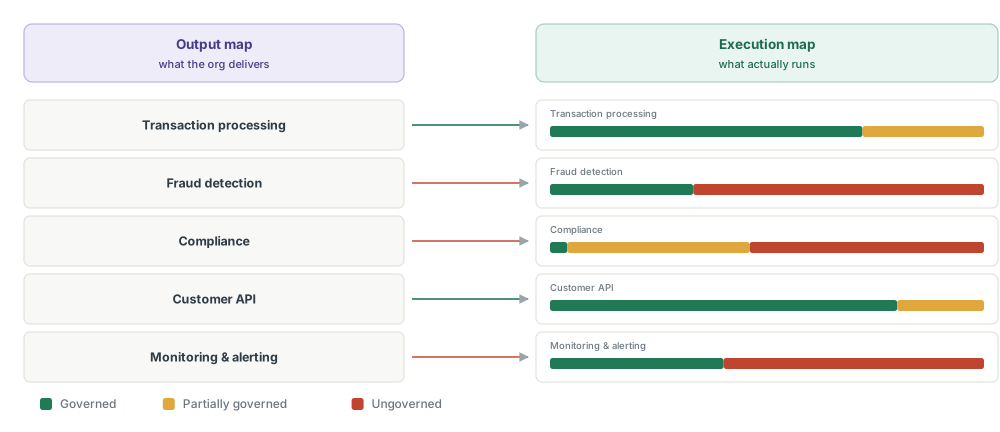
Bar fill shows governance health per execution domain. Connector arrow color indicates overall domain risk. Three of five arrows are coral — the gap is not theoretical.
THE TENSION BETWEEN OUTPUT AND EXECUTION
The temptation in any well-run organization is to manage to outputs. Outputs are legible, comparable, and directly connected to the business. If the team is shipping, the team is performing. If the product is working, the system is working.
This temptation becomes dangerous in a hybrid organization — because the execution surface can degrade significantly while outputs remain stable. Automation that nobody owns continues to run. AI models that nobody monitors continue to produce outputs. Compliance logic that nobody reviews continues to pass. The system works, until it doesn't — and when it breaks, the failure is often traced back to an execution layer that was never in anyone's ownership model.
The tension between output and execution is not a technology problem. It is an organizational one. It exists because the org was designed to produce and measure outputs, but was not designed to govern the execution surface that produces them.
A CTO who manages only to the output map is managing the visible portion of a system that is larger than what they can see.
THE FAILURE MODE
The failure mode here is not a governance failure in the operational sense. A CTO with the right cadences, the right mandate, and the right decision architecture in place will catch many of the risks that accumulate on an ungoverned execution surface. The Operating System is designed precisely for that.
But governance operates on what the organizational design has made visible. Cadences surface what has been mapped. Accountability structures cover what has been owned. The failure mode this chapter is concerned with is upstream of governance — it is the structural condition in which significant portions of the execution surface were never mapped, never owned, and therefore never reached the governance layer at all.
An automated compliance check that no team owns does not appear in a sprint review. An AI model with degrading outputs does not appear on a risk register if nobody is accountable for monitoring it. A vendor execution dependency does not surface in a planning cadence if the organization has not structurally recognized it as part of its execution model.
The Operating System gives the CTO the instruments to govern. This chapter is concerned with whether the instrument panel is connected to the right systems. When the organizational design does not formally account for the full execution surface, the governance layer — however well designed — is operating with incomplete inputs.
That is the structural failure this chapter addresses.
THE STRUCTURAL CORRECTION
Mapping the execution surface is an organizational design act, not a documentation exercise. It is the process of making visible what actually runs — and assigning structural ownership to every component of it.
This means extending the ownership model beyond the human layer. Every automated process has an owner. Every AI agent has an owner. Every platform dependency has an owner. Ownership does not mean the owner built it, maintains it daily, or understands every technical detail. It means they are accountable for its performance, its governance, and its alignment with the organization's execution standards.
In practice, this requires two things the traditional org chart does not provide. First, a clear taxonomy of execution components — a shared language for describing what runs, at what layer, and what role it plays. Second, an ownership model that explicitly covers the non-human execution layer — not as an afterthought, but as a primary design consideration.
The execution surface should be treated as a first-class organizational asset. It is what the organization runs on. It deserves the same clarity of ownership, the same governance discipline, and the same design attention as the human layer it works alongside.