
Chapter 9: The Platform Layer
Every hybrid organization depends on a layer of internal infrastructure that makes everything else possible. The deployment systems that move code to production. The data pipelines that feed decisions. The observability tooling that surfaces what is happening across the system. The shared services that product teams depend on to execute without rebuilding foundational capability from scratch.
This layer has a name — the platform — and in most technology organizations it is treated as a support function. The platform team exists to serve the product teams. It responds to requests, resolves dependencies, and maintains the infrastructure that product teams need. Its success is measured by the satisfaction of its internal customers and the absence of incidents that disrupt product delivery.
That framing is wrong — not in its intentions, but in its structural consequences. A platform treated as a support function will be designed, resourced, and governed like a support function. It will be reactive rather than architectural. It will be sized to serve current demand rather than built to enable future scale. It will be evaluated on service quality rather than on the capability it provides to the organization's execution model.
In a hybrid organization, the platform layer is not a support function. It is a structural foundation — the organizational primitive on which the execution model is built.
THE CORE IDEA
A platform is the layer of internal infrastructure that enables the organization's execution surface to function at scale. It is not what product teams deliver — it is what product teams stand on. The distinction is architectural, not cosmetic.
The platform does not support execution. It defines the boundary of what execution is possible.
This is the claim that separates a platform-as-foundation from a platform-as-service. A service organization responds to what teams need today. A structural foundation determines what the organization is capable of doing — at what execution modes, at what scale, with what governance. When the platform is well-designed and ahead of the execution model's needs, new capabilities are composable: teams build on shared infrastructure rather than reconstructing it from scratch. When the platform is reactive and behind, new capabilities are reconstructive: every team rebuilds what the platform should have provided, inconsistently and at high cost.
In a human-centric organization, this distinction matters less. Product teams can function with imperfect infrastructure. They compensate with human effort — working around limitations, rebuilding shared capabilities locally, accepting friction as a cost of doing business. The organizational cost of a weak platform is real but diffuse — slower delivery, duplicated effort, inconsistent quality — and it is absorbed by the human layer rather than surfacing as a visible structural failure.
In a hybrid organization, the distinction becomes critical. The execution surface depends on the platform in a way that the human layer does not. Automated pipelines run on the platform. AI agents depend on the platform's data and tooling. System-led workflows rely on the platform's observability and governance infrastructure. When the platform is weak, the non-human execution layer is either constrained, unstable, or ungovernable — and no amount of human effort can fully compensate.
The platform is also where governance becomes real. The platform is where governance moves from policy to enforcement. Without platform-level enforcement — consistent deployment standards, shared observability, governed integration patterns — governance exists only as intention. Individual teams can commit to governance principles. Only the platform can make them structurally unavoidable. This connects the platform directly to the ownership model in Chapter 3, the execution modes in Chapter 4, and the governance capacity model in Chapter 8: the platform is not just execution infrastructure, it is control architecture.
The platform layer is therefore not optional infrastructure in a hybrid organization. It is the structural foundation that determines whether the execution surface can be designed, governed, and scaled effectively. This has three direct implications for how the platform layer must be treated:
It must be designed proactively, not reactively. A platform built to serve today's product team requests is always behind. A platform designed as an organizational primitive is built ahead of the execution model it will support.
It must be resourced as infrastructure, not as a service team. The platform's headcount, governance model, and investment level should reflect the criticality of the infrastructure it provides — not the volume of requests it receives.
It must be governed with the same rigor as the product layer. The platform's systems are part of the organization's execution surface. They must be owned, monitored, and actively improved — not maintained reactively in response to incidents.
THE DIAGRAM
Figure: Platform layer as structural foundation
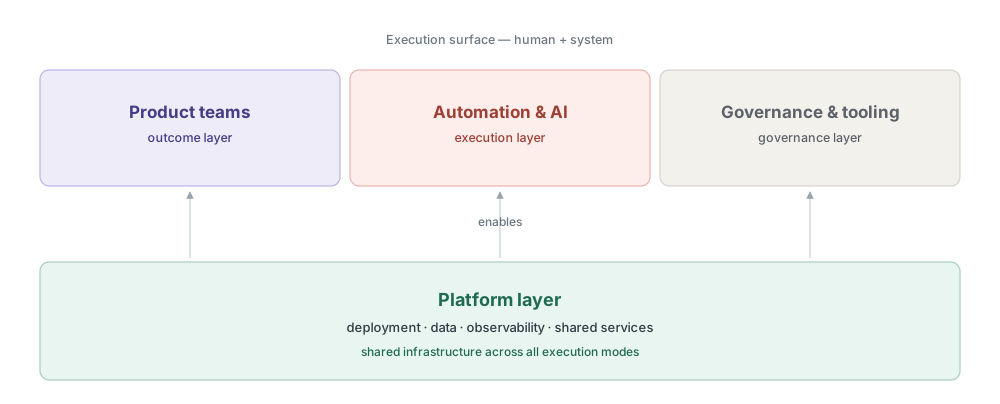
The execution surface — product teams, automation and AI, governance and tooling — rests on the platform layer. The platform is not a peer component. It is the structural foundation that determines what execution is possible.
WHAT THIS LOOKS LIKE
A fintech organization has three product teams — payments, lending, and fraud — each building and operating product features for external customers. All three depend on a shared platform that includes a deployment pipeline, an event streaming infrastructure, a data platform, an observability stack, and a shared authentication service.
In the support function model, the platform team responds to the needs of the three product teams. When payments needs a new deployment configuration, the platform team builds it. When fraud needs a new data connector, the platform team prioritizes it in its backlog. In this model, product teams define the platform backlog. The platform team's roadmap is a reflection of accumulated product team requests. Its success is measured by how quickly it resolves tickets, how rarely it causes incidents, and how satisfied the product teams are with the service.
The platform team in this model is permanently behind. It is staffed to handle current load, not to build ahead of future need. When the organization wants to add AI capabilities — a fraud detection model, a personalization engine, a document processing pipeline — the platform does not have the infrastructure to support them. The data platform cannot handle the volume and latency requirements. The observability stack cannot monitor AI model behavior. The deployment pipeline cannot manage model versioning and rollback. Each product team begins building its own workarounds — its own lightweight data infrastructure, its own model monitoring, its own deployment tooling. The execution surface fragments. The governance model becomes inconsistent. The organization has nominally added AI capability but structurally degraded its execution model.
In the structural foundation model, the execution model defines the platform roadmap — not the accumulation of product team requests. The platform team is designed around the organization's execution model requirements — both current and anticipated. When AI capabilities are being adopted across the organization, the platform team builds the infrastructure that enables those capabilities to be deployed, monitored, and governed consistently — before each product team arrives with its own requirements.
The platform team in this model is smaller than the product teams it serves but strategically more consequential. It is not optimizing for request volume. It is optimizing for the organizational capability its infrastructure enables. The test of its success is not whether product teams are satisfied with the service — it is whether product teams can build and govern their execution surfaces effectively on the foundation the platform provides.
THE PLATFORM LAYER AS EXECUTION MULTIPLIER
The structural importance of the platform layer in a hybrid organization is best understood through its multiplier effect on the execution surface.
When the platform is strong — well-designed, well-governed, and built ahead of the execution model's needs — every team that builds on it inherits a foundation they do not have to build themselves. A product team deploying an AI agent on a mature platform gets model monitoring, versioning, rollback capability, and governance tooling without building any of it. New capability is composable: teams add to the execution surface by building on shared infrastructure. The marginal cost of adding a well-governed AI agent is low, because the platform provides the foundation that makes governance possible.
When the platform is weak — reactive, fragmented, or built to serve current requests rather than future scale — new capability becomes reconstructive: every team rebuilds what the platform should have provided. A product team deploying an AI agent on a weak platform must build its own monitoring, its own versioning, its own governance tooling. Most teams respond by either building inadequate governance in the time available, or skipping governance entirely and accepting the risk. The execution surface grows. Governance quality degrades. The organization adds capability faster than it can govern it.
The platform determines whether new capability is composable or reconstructive. That single distinction is the mechanism by which the platform layer determines whether the cost curve flattens as the organization scales. An organization with a strong platform adds execution surface capability at relatively low marginal cost per capability added, because the governance infrastructure is shared. An organization with a weak platform adds execution surface capability at high marginal cost, with governance quality that degrades as the pace of addition outstrips the capacity of individual teams to build their own infrastructure.
It is not the product teams that bend the cost curve. It is the platform layer that either enables or prevents them from doing so.
THE FAILURE MODE
The failure mode specific to the platform layer is the service trap — when the platform is designed and managed as a service organization for product teams rather than as the structural foundation of the execution model.
The service trap is easy to fall into because it feels like the right design. Product teams are internal customers. The platform should serve them. Their satisfaction is a reasonable proxy for the platform's performance. Organizing the platform around their requests and measuring its success by their satisfaction sounds like good organizational design.
The structural consequences accumulate slowly and are initially invisible. The platform roadmap is dominated by short-term requests rather than long-term infrastructure investment. The platform team is staffed reactively — sized to handle current demand rather than built to enable future capability. The platform's architecture reflects the accumulated history of individual product team requests rather than a coherent design for the organization's execution model.
When the organization tries to scale its execution surface — adding AI capabilities, expanding automation, building new system-led workflows — the platform is not ready. It cannot support the governance requirements of the new execution modes. Product teams build around it. The execution surface fragments. Governance becomes inconsistent. The organization discovers, too late, that what felt like responsive service was actually deferred infrastructure investment.
The platform was a support function. The execution model needed a structural foundation.
THE STRUCTURAL CORRECTION
Govern the platform as infrastructure, not as a service. The platform team's charter should describe the infrastructure it owns and the execution model it enables — not the service it provides to product teams. Its roadmap should be driven by the organization's execution model requirements, not by the backlog of product team requests. Product teams are stakeholders in the platform's direction, not its customers in the service sense.
Resource the platform based on infrastructure criticality, not request volume. The platform team's headcount, investment level, and governance model should reflect the criticality of the infrastructure it provides to the execution surface. An organization where the platform underpins every product team's execution surface, every AI agent's governance model, and every automated workflow's deployment infrastructure should invest in the platform accordingly — not size it to handle a service queue.
Evaluate the platform on execution model enablement, not service quality. The right evaluation questions are: can product teams build and govern their execution surfaces effectively on the foundation the platform provides? Is the platform's capability growing ahead of the execution model's needs, or is it perpetually catching up? Is the governance infrastructure the platform provides sufficient for the execution modes the organization is deploying?
Build the platform ahead of the execution model. The platform team must maintain enough architectural foresight to understand where the organization's execution model is heading and build the infrastructure that will support it before individual product teams arrive with requirements. This requires the platform team to be in the strategic conversation about the organization's execution direction — not just in the operational conversation about current product team needs.