
Appendix B - Centralize vs. Distribute: Positioning Audit
This audit applies the framework from Chapter 10 to your organization's current structure. It works through four capability categories — platform infrastructure, governance standards, execution ownership, and data and analytics — and assesses each against its recommended default positioning.
The output is a positioning alignment score, a category-level assessment with structural corrections for each gap, and a prioritized correction list with time-to-fix signals distinguishing corrections that can begin immediately from those that require a structural program.
The audit is designed to be run directly in the interactive tool and presented in a leadership conversation. It is a recurring instrument — not a one-time exercise. Revisit it when the organization grows significantly, when the execution model changes, or when failure mode symptoms appear.
HOW THE AUDIT WORKS
The audit has four steps — one per category. Each step asks three questions: where does this capability currently sit on the centralize vs. distribute spectrum, whether that positioning is the result of an explicit decision, and whether the organization is experiencing the failure mode symptoms associated with misalignment in that category.
Each answer is scored. The combination of positioning, decision quality, and symptom presence produces a category status: Aligned, Needs attention, or Misaligned. The overall score is the aggregate across all four categories expressed as a percentage of the maximum possible alignment.
Where a category is not aligned, the tool generates a structural correction — the specific design action required — and a time-to-fix signal. Corrections marked 'Can start now' require a decision and a named owner, not a restructuring. Corrections marked 'Structural program' require investment, capability transfer, or architectural separation and should be treated as sequenced design work.
THE FOUR CATEGORIES
| # | CATEGORY | WHAT IT ASSESSES | FAILURE SIGNAL |
|---|---|---|---|
| 1 | Platform infrastructure Default: Centralized | Whether shared deployment, observability, and data infrastructure is owned by a dedicated platform team or fragmented across product teams. | Fragmentation |
| 2 | Governance standards Default: Centralized | Whether automation and AI governance standards are owned and enforced consistently, or applied at individual team discretion. | Ungoverned surface |
| 3 | Execution ownership Default: Distributed | Whether product teams own the execution surfaces that produce their outcomes, or whether a shared team carries that ownership on their behalf. | Service trap |
| 4 | Data & analytics Default: Contextual | Whether data infrastructure is centralized and model/insight ownership is distributed to the product domains that depend on them. | Disconnected accountability |
WHAT THE OUTPUT LOOKS LIKE
The tool produces a four-part output. The positioning alignment score is an aggregate percentage — a single number that reflects the organization's overall positioning health across all four categories. The category assessment shows the status of each category, the finding that explains it, and the structural correction if one is required. The prioritized correction list orders all required corrections by severity — most misaligned first — with a time-to-fix signal on each. A reset option allows the audit to be run again as conditions change.
Sample output — illustrative results
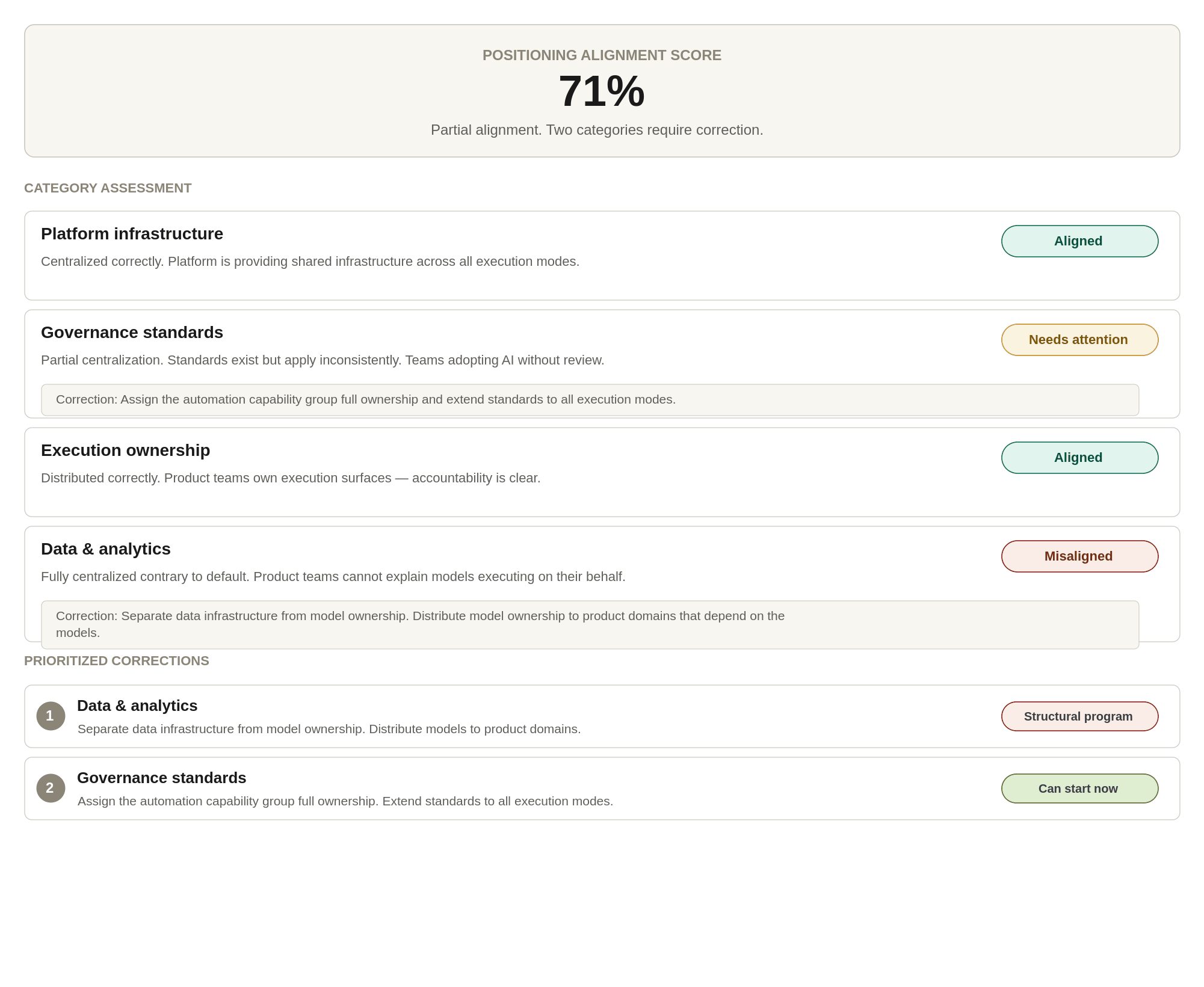
The sample above shows an organization with two misaligned categories — governance standards needing attention and data and analytics fully centralized — producing a 71% alignment score and two prioritized corrections.
USING THE RESULTS IN A LEADERSHIP CONVERSATION
The audit output is designed to be presented directly to the leadership team — COO, CFO, CPO — without requiring them to have read Chapter 10. The alignment score gives the conversation an anchor. The category assessment explains what is driving the score in structural terms each leader can recognize. The prioritized correction list tells the room what needs to happen, in what order, and whether each correction can begin immediately or requires a program.
For corrections marked 'Structural program,' the conversation should establish ownership, resourcing, and a target timeline before it closes. For corrections marked 'Can start now,' the conversation should close with a named owner and a first action — not a follow-up meeting.
The audit is not a one-time event. The positioning of these four categories shifts as the organization grows and the execution model evolves. Running it annually — or at any significant inflection in scale or execution model — ensures the structural design keeps pace with what the organization is actually running.