
Chapter 22: The Operating Cadence in a Hybrid Org
Every well-run organization has a cadence. The sprint that governs team delivery. The monthly review that checks execution health. The quarterly session where leadership makes strategic adjustments. The annual planning cycle that sets direction for the year ahead. These rhythms are not bureaucracy — they are the mechanism by which a distributed organization stays aligned, surfaces problems early, and makes decisions at the right level on the right timeline.
In a traditional organization, cadence is relatively simple to design. The unit of execution is the human team. The unit of governance is the same. Sprint reviews cover what teams built. Monthly reviews check how teams are performing. The cadence structure serves both delivery and governance because the same entity — the human team — is responsible for both.
In a hybrid organization, this alignment breaks down. The human execution layer continues to run on periodic rhythm. The system execution layer runs continuously — without sprints, without monthly reviews, without any inherent cadence at all. A pricing algorithm does not pause for a sprint retrospective. A fraud detection model does not check in at the monthly review. A data pipeline does not appear on the quarterly OKR update unless someone explicitly puts it there.
The operating cadence of a hybrid organization must therefore be designed for two layers, not one — and for the interaction between them.
THE CORE IDEA
The human execution layer and the system execution layer do not share a cadence. They require two different governance rhythm structures, synchronized at defined points.
The human execution layer runs on periodic rhythm by design. Teams have sprints, managers have one-on-ones, leadership has quarterly reviews. This rhythm is familiar and relatively well understood. It governs delivery, development, and decision-making across the human part of the organization.
The system execution layer runs continuously by nature. A deployed executor does not have a sprint. It processes whatever reaches it, at whatever volume, on whatever schedule its inputs demand. Governance of the system layer cannot wait for a periodic human review cycle — because the system is making consequential decisions in between those cycles, and those decisions accumulate.
This creates the core cadence design problem of a hybrid organization: how does the human review structure stay relevant when the system it is reviewing never stops? The answer is not to slow the system down to match the human cadence. The answer is to design a separate governance cadence for the system layer — one that is calibrated to the continuous nature of system execution — and to synchronize it with the human cadence at defined interaction points.
The interaction points are where the two layers touch: escalations that route from system execution to human review, recalibrations that require both governance owner and purpose owner, mode-change decisions that require leadership involvement, and model-level decisions that set the strategic frame for everything below. These interaction points are not ad hoc. They are structural — designed into the cadence before the system is deployed.
The operating cadence is the temporal expression of the decision architecture from Part IV. It determines when each of the four decision types from Chapter 17 is expected to occur: authorization decisions are event-triggered at deployment and reviewed monthly; delegation decisions surface at the quarterly governance session; recalibration decisions are signal-triggered weekly and backstopped quarterly; model-level decisions are made quarterly and reviewed annually. Cadence and decision architecture are not independent systems — the cadence is how the decision architecture runs in time.
Figure: Operating cadence — 12-month timeline
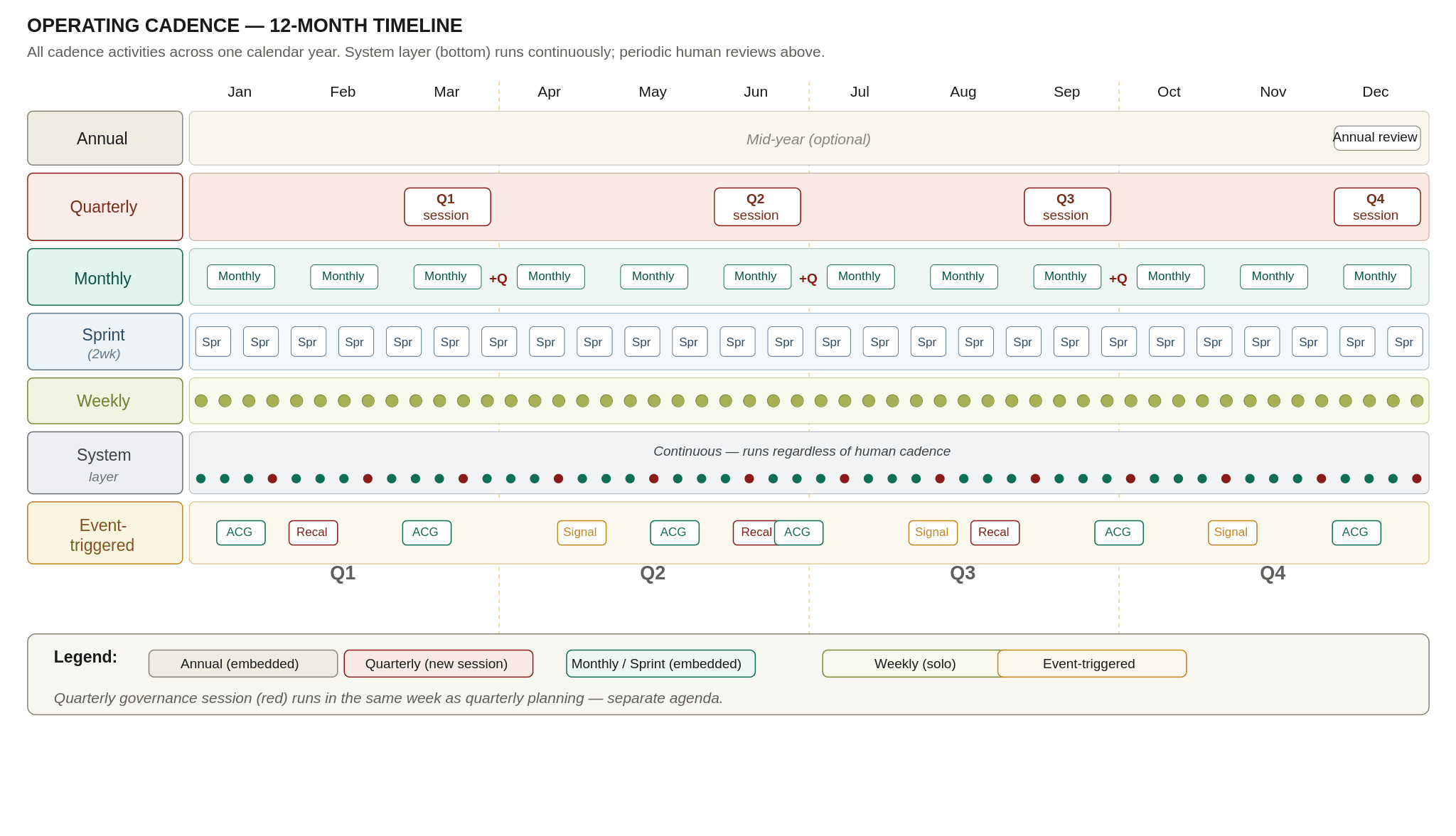
All cadence activities across one calendar year. Quarterly governance sessions (red, Q1–Q4) are the only new dedicated sessions. Monthly and sprint activities are embedded. Weekly monitoring is a solo activity. The system layer (bottom) runs continuously regardless of human review cycles.
Figure: CTO Operating System cadence vs hybrid org operating cadence
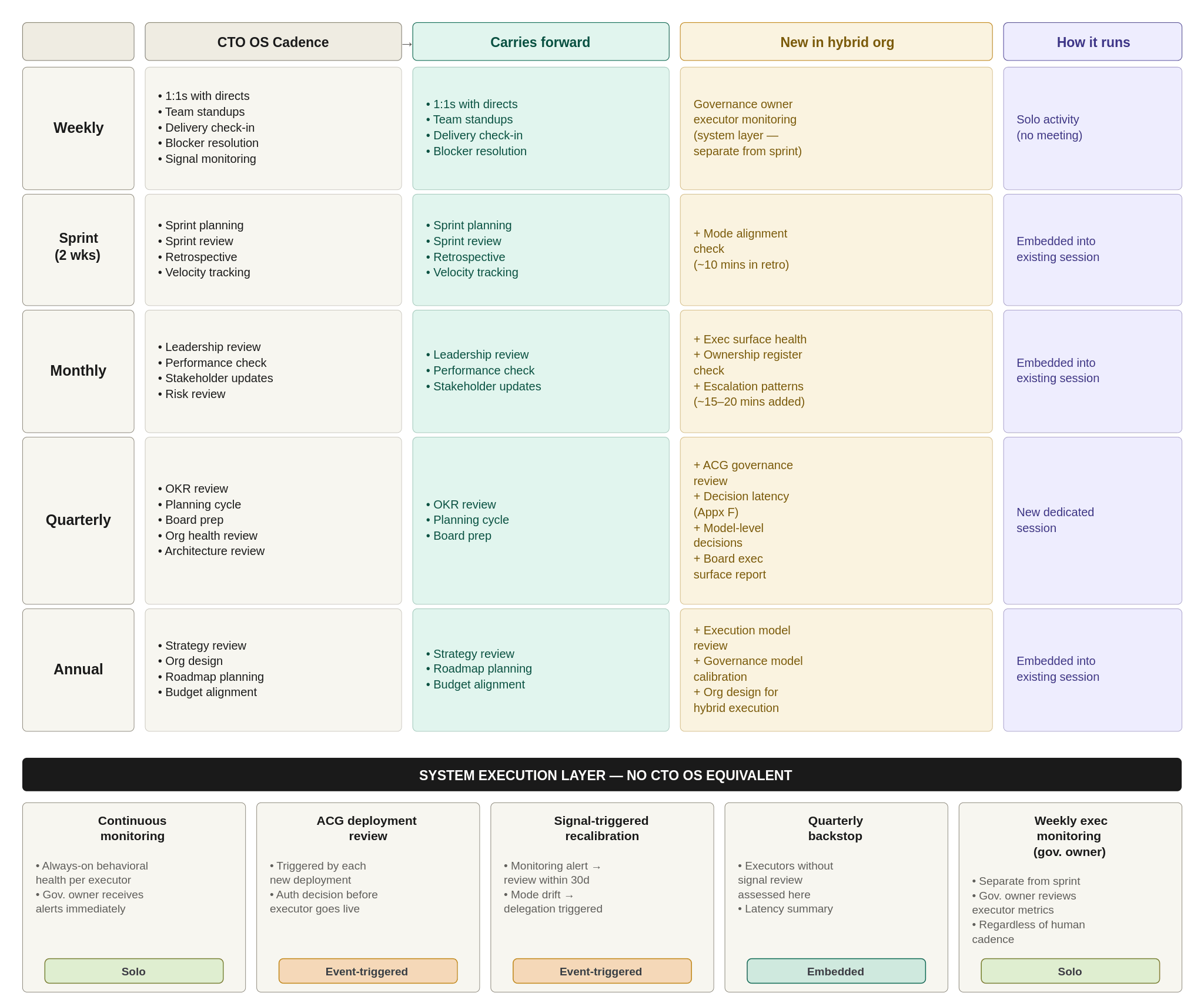
The 'How it runs' column shows whether each addition is embedded into an existing session, a new dedicated session, or a solo governance owner activity requiring no meeting. Weekly executor monitoring and most system layer activities are solo. Monthly additions are embedded. The quarterly governance review is the only new dedicated session.
Figure: Dual-cadence architecture — human layer and system layer with interaction surface
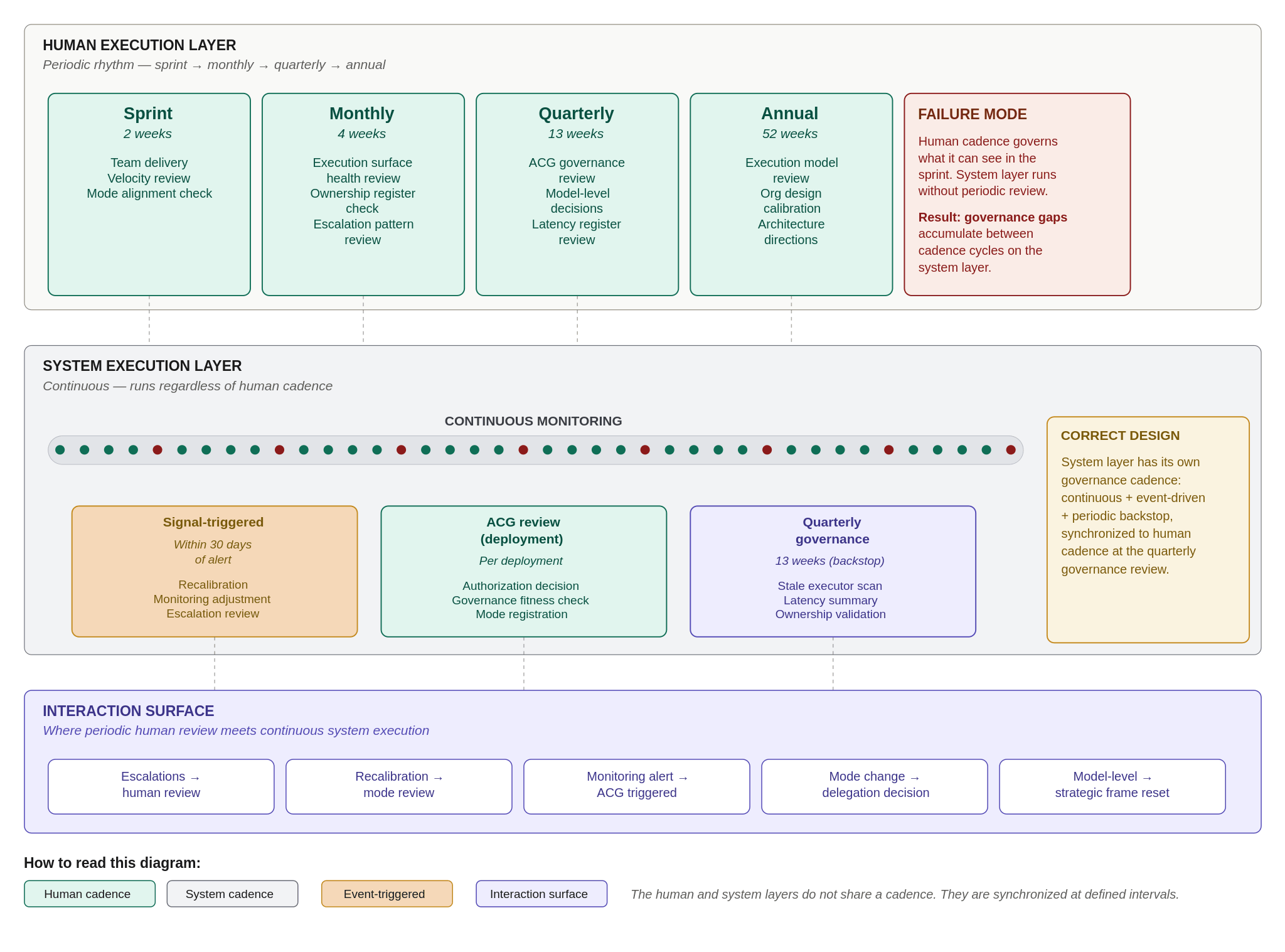
The human and system layers do not share a cadence. The system layer runs continuously with event-triggered reviews and a quarterly backstop. The two layers synchronize at the interaction surface: escalations, recalibrations, mode changes, and model-level decisions.
WHAT CHANGES — AND WHAT DOESN'T
What doesn't change. The need for rhythm does not change. Periodic review cycles remain essential — for delivery alignment, for executive decision-making, for organizational learning. The sprint, monthly, quarterly, and annual cadences remain the right structure for governing the human execution layer. What they govern, and what governance content they are expected to carry, is what changes.
Before addressing each cadence level, one structural question needs a direct answer: are these additions new sessions, or additions to existing ones? The answer is differentiated. Most additions are embedded into existing sessions — agenda items, not new calendar events. The weekly governance monitoring is a solo activity, not a meeting at all. Only one level — the quarterly — requires a genuinely new dedicated session, because the governance content is too substantial to compress into an existing OKR review without crowding out either the delivery agenda or the governance agenda. This distinction is visible in the diagram above.
What changes at the sprint level. The sprint is primarily a delivery and team coordination mechanism. In a hybrid organization it also carries a lightweight mode alignment check: are the execution modes the team is operating in still correct for the work they are doing? This is not a formal governance review — it is a standing question in the sprint retrospective or planning session. Is any workflow that was running in human-assisted mode now ready for system-led? Is anything in system-led mode showing drift that warrants a closer look? The sprint is the first signal layer for mode misalignment. It is not the mechanism for executor behavioral monitoring — that governance activity belongs to the system layer cadence and runs continuously regardless of sprint boundaries.
What changes at the monthly level. The monthly review in a hybrid organization carries explicit execution surface health as a standing agenda item. This means: has the ownership register changed? Are all executors on the surface currently assigned to active owners? Has any escalation pattern emerged that suggests the escalation surface needs redesign? Has any monitoring alert gone unacknowledged? These are not deep governance reviews — they are status checks that ensure nothing on the system layer has drifted without notice between quarterly reviews.
What changes at the quarterly level. The quarterly is the only cadence level that requires a new dedicated session rather than additions to an existing one. The ACG governance review, decision latency register, model-level decisions, and board report preparation together constitute ninety to one hundred and twenty minutes of substantive governance work — too much to absorb into the existing OKR and planning cycle without crowding out both agendas. The quarterly governance session runs alongside the planning cycle in the same week, with a separate agenda: governance health of the execution surface rather than delivery performance. The CTO owns this session and does not delegate it.
What changes at the annual level. The annual review in a hybrid organization includes an execution model review alongside the traditional organizational design review. The question is not just whether the org structure is right for the business — it is whether the distribution of execution modes, the governance model, and the decision architecture are right for the execution surface the organization now has. As the surface grows and matures, the annual review is the cadence at which structural changes to the governance model are made deliberately rather than reactively.
THE SYSTEM LAYER'S OWN CADENCE
The system execution layer requires a governance cadence that is separate from the human review cycle. It has three components.
Continuous monitoring. The system layer is monitored continuously. Behavioral drift signals, performance anomalies, escalation patterns, and authorization failures are surfaced in real time to the governance owners responsible for each executor. This is not a cadence in the periodic sense — it is an always-on signal layer. Its governance output is immediate: when a signal crosses a threshold, it triggers a response within the timeframe established in the authority grant record, not at the next scheduled review.
Event-triggered reviews. Certain system events trigger governance reviews independent of the periodic calendar. A new deployment triggers an ACG authorization review. A monitoring alert that meets the threshold defined in the recalibration protocol triggers a recalibration assessment. A mode-change recommendation from the recalibration process triggers a delegation review at leadership level. These event-triggered reviews are not additions to the calendar — they are responses to system conditions that cannot wait for a scheduled cadence.
Periodic backstop. The quarterly governance review serves as the backstop for the system layer: the point at which any executor that has not been reviewed through a signal-triggered or event-triggered process is assessed for governance fitness. The quarterly backstop is not a substitute for the other two components — it is the catch-all that ensures no executor ages past twelve months without any review. An organization whose system-layer governance depends entirely on the quarterly backstop is an organization whose monitoring model is not functioning.
RHYTHM AS A STRUCTURAL CHOICE
The operating cadence is not an operational detail. It is a structural commitment about how the organization stays connected to what it is actually doing. A cadence that only reviews the human layer is a cadence designed for an organization that only has a human layer. In a hybrid organization, that cadence is structurally incomplete.
The design question for the operating cadence is not which meetings to schedule. It is: for each element of the execution surface — human and non-human — is there a defined governance review cycle that is calibrated to the nature of that element? Human teams need periodic rhythm because humans coordinate in time. Automated systems need event-triggered and backstop governance because they execute continuously without the natural coordination points that human teams provide.
An organization that has designed its cadence for both layers does not need more meetings. It needs cadence content that is different from what a purely human organization requires. The sprint retrospective carries a mode alignment check. The monthly review carries an execution surface status. The quarterly review carries the full governance health assessment. The annual review carries the execution model design question. None of these add significant meeting time — they add governance substance to reviews that are already happening.
What they require is that someone has thought through what governance content belongs at each level — not just what delivery content, not just what performance content, but what governance content. In most hybrid organizations, this thinking has not been done. The result is reviews that are well-run but structurally incomplete: they cover the human layer thoroughly and leave the system layer ungoverned by default.
The failure mode is cadence designed entirely for the human layer, applied to an organization that also has a substantial system layer. In this organization, sprints review team delivery. Monthly sessions review team performance. Quarterly reviews cover OKRs and organizational health. Annual reviews set direction and structure. All of this is done well.
And the execution surface runs between these reviews without periodic governance. Executors drift. Monitoring models generate alerts that reach no one. Ownership assignments go stale as teams reorganize. Mode creep accumulates — workflows that were authorized for human-assisted execution quietly slide toward system-led because the review step becomes perfunctory and nobody triggers the delegation process that the mode change requires.
When something fails — an executor produces a pattern of poor decisions, a governance gap produces a regulatory issue, a mode drift produces an incident — the investigation reveals that the last formal review of the relevant executor happened at the quarterly session fourteen months ago. The cadence was running. The system layer simply was not in it.
The correction is not to add a dedicated governance calendar. It is to embed governance content for the system layer into the existing cadence structure — ensuring that every review level carries the governance content appropriate to its frequency and its position in the decision architecture.