Every organization makes decisions about its execution surface — what gets automated, what stays human, how far authority travels into systems, when the design needs to change, and who has standing to change it. In a human organization, most of these decisions are invisible as a category because the execution surface and the human organization are the same thing. In a hybrid organization they are distinct, and the decisions that shape the execution surface require their own architecture.
This chapter does not classify decisions by where they occur. It classifies them by what they control: the execution surface itself.
In practice, a CTO defines these decision types before building the structures that support them. In this document, they appear after — because the structures they govern must first be made explicit.
THE CORE IDEA: FOUR DECISION TYPES
All decisions that shape the execution surface fall into four categories, each requiring a different process. An organization that routes all four through the same process will systematically make the wrong decisions at the wrong speed with the wrong people in the room.
Figure: Decision types — owners, processes, execution mode relationship, and timing
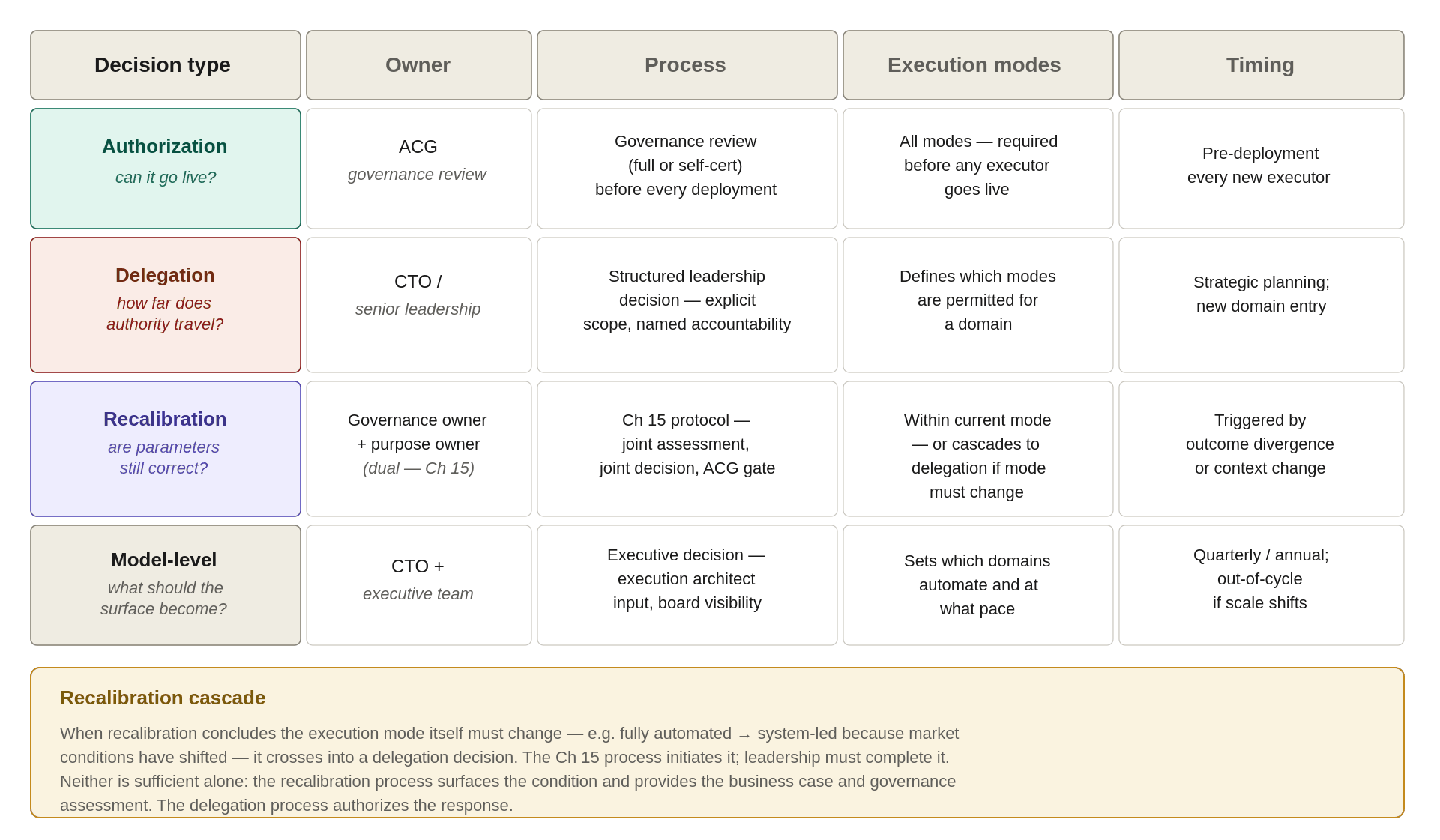
Each decision type controls a distinct aspect of the execution surface and requires a distinct process. Routing all four through the same process is the single-process failure mode that produces governance theater rather than governance.
AUTHORIZATION: CAN IT GO LIVE?
Authorization decisions determine whether a specific executor is permitted to operate on the execution surface at all. These are pre-deployment decisions: is the execution mode appropriate for this workflow, is the governance infrastructure in place, is ownership assigned, and does the deployment meet ACG standards? Authorization decisions are owned by the ACG through the governance review process established in Chapter 13. They are made before deployment — not after. A deployment that proceeds without one has created ungoverned execution surface at the moment it goes live.
DELEGATION: HOW FAR DOES AUTHORITY TRAVEL?
Delegation decisions determine how far authority travels into the system — what class of decisions the organization is willing to have a system make, at what consequence level, and within what parameters. These are structural design choices that belong at the CTO or senior leadership level for consequential domains. A delegation decision made carelessly produces an executor operating with authority the organization did not actually intend to give it.
RECALIBRATION: ARE PARAMETERS STILL CORRECT?
Recalibration decisions determine when an executor's design parameters need to change because conditions have shifted since deployment. These are mid-lifecycle decisions: the executor is operating, the governance model is functioning, but the world has changed and the executor's design no longer serves its intended purpose well. Chapter 15 established the ownership structure for this — recalibration requires the explicit joint agreement of the governance owner and the purpose owner, with leadership sign-off for high-consequence changes. Neither owner can initiate the change unilaterally.
MODEL-LEVEL: WHAT SHOULD THE SURFACE BECOME?
Model-level decisions define the strategic frame within which all other execution surface decisions operate — which domains should automate, at what pace, and whether the governance model remains adequate as the surface grows. They belong at the CTO and executive level, informed by the execution architect's aggregate view and the ACG's governance fitness assessment, and carry board-level visibility on the dimensions of risk and investment.
WHY EACH TYPE REQUIRES A DIFFERENT PROCESS
The most consequential implication of this taxonomy is also the most easily overlooked: the four decision types must not be routed through the same decision process.
Authorization decisions follow the ACG governance review process. Full review for high-consequence deployments, self-certification for routine ones. The ACG owns this process. Leadership involvement in an individual deployment review is a symptom of a mis-calibrated review process, not governance rigor.
Delegation decisions follow a structured leadership process. Deliberately slow — not bureaucratic, but deliberate. A delegation decision made quickly and carelessly produces an executor operating with authority the organization did not actually intend to give it.
Recalibration decisions follow the Chapter 15 protocol. Joint assessment, joint decision, governance owner execution, ACG review gate. When the recalibration concludes that the mode must change, it escalates to the delegation process — it does not complete itself.
Model-level decisions follow an executive decision process. Typically the CTO working with the execution architect and ACG lead, presenting to the board on execution surface risk, governance fitness, and strategic platform investment. The cadence is quarterly or annual, with out-of-cycle decisions triggered by significant changes in technology capability, regulatory environment, or organizational scale.
THE FAILURE MODE
The failure mode specific to this chapter is the single-process organization — one decision process for everything that touches the execution surface. It looks like governance. It produces the opposite: a process too slow for authorization, too shallow for delegation, wrong ownership structure for recalibration, and wrong level for model decisions. Teams route around it. The execution surface grows faster than the governance model can track.
The second failure mode is the cascade that never escalates. A recalibration that reveals a mode change is needed but is treated as a routine parameter adjustment — completed within the dual ownership process without triggering a delegation decision — produces an execution mode change that leadership never authorized. The mode shifts. The delegation scope changes. No one at leadership level knows it happened or accepted accountability for whether the shift was appropriate.
