Chapter 3 established that the ownership gap exists — that hybrid organizations accumulate execution surfaces that no one is actively accountable for. It named the structural causes: teams reorganize without transferring ownership, systems outlive the people who understood them, vendor capabilities enter without owners assigned.
The primary failure mode of hybrid organizations is not technology. It is ownership that does not extend across the execution surface.
This chapter does not repeat that diagnosis. It answers the next question: what does ownership actually mean when the executor is not a person?
That question matters because ownership is not a uniform responsibility. Owning an automated pipeline is not the same as owning an AI agent. Owning a vendor execution dependency is not the same as owning either. Each executor type has a different behavioral profile, a different failure mode, and a different set of responsibilities for the person assigned to own it. The execution mode of a workflow also changes what the owner is concretely required to do — and in system-led workflows, the system owner and the escalation recipient are often two different people with two different accountability profiles.
Without a precise definition of what ownership means by executor type, the ownership register is a list of names without a job description. This chapter provides the job description.
THE CORE IDEA: FIVE OWNERSHIP COMPONENTS
Ownership in a hybrid organization is active accountability for a specific executor's current behavior, governance fitness, and continued alignment with organizational standards. The word active is load-bearing. It distinguishes ownership from authorship — who built it, from custody — who is nearest to it, and from nominal assignment — whose name appears in a document.
Active ownership has five components regardless of executor type. What changes by executor type is the specific work each component requires.
Know the current state. The owner knows whether the executor is performing correctly right now. Not at the time it was built. Not in principle. Now. This requires monitoring, defined performance standards, and a regular review process. If the owner cannot describe current performance, they do not own the executor in any meaningful sense.
Keep the mode honest. The owner ensures the executor's execution mode — human-led, human-assisted, system-led, or fully automated — reflects what is actually happening in practice, not just what is documented. Execution modes drift. A human-assisted workflow where the review step has become perfunctory is not genuinely human-assisted — it is producing unreviewed outputs while carrying the governance label of a governed process. The owner catches and corrects this gap.
Maintain relevance. The owner ensures the executor remains fit for its current purpose as conditions change. Where 'know the current state' asks whether the executor is performing correctly now, 'maintain relevance' asks whether it should still be behaving this way at all. Requirements shift. Regulatory rules update. Upstream data changes. The executor continues running against its original design. The owner is accountable for ensuring that design remains aligned with the world it operates in — not just at deployment, but continuously.
Document what you know. The owner maintains a living record of the executor's current behavior, known edge cases, dependency structure, and ownership history. Without documentation, ownership is personal knowledge that disappears when the owner changes roles or leaves. With it, ownership is organizational knowledge that survives transitions. Documentation is not a cleanup task. It is a core ownership responsibility — and its absence is what makes ownership transfer nominal rather than real.
Hand it over cleanly. When the owner leaves the role — through reorganization, a role change, or departure — they ensure ownership is explicitly transferred rather than abandoned. This is not the organization's responsibility to initiate. It is the owner's. A clean handover transfers not just the name but the documented understanding, the behavioral history, and the relationship context that make the incoming owner functional from day one.
Figure: Ownership framework by executor type
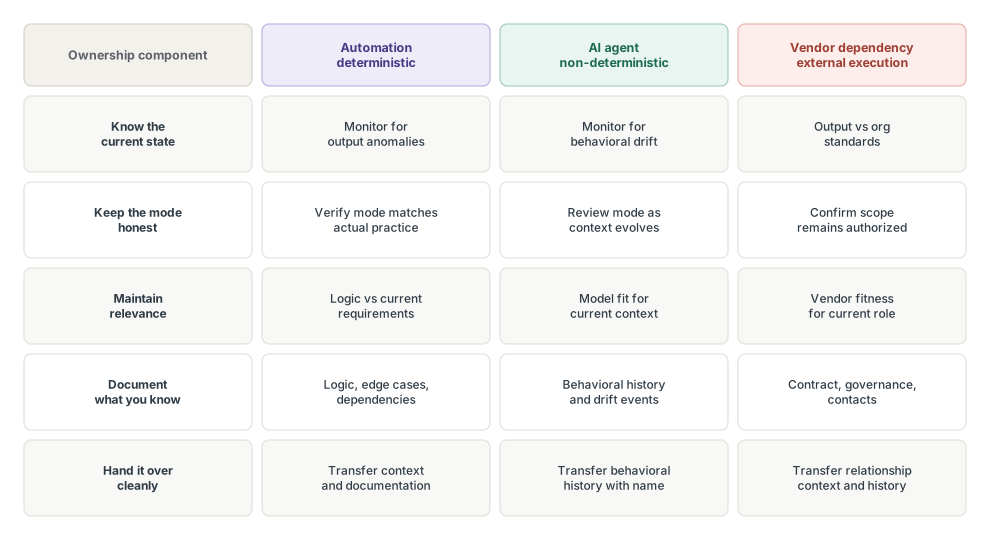
Each cell describes the primary obligation for that component-executor combination. The job description for any owner is the column of cells under their executor type.
OWNERSHIP BY EXECUTOR TYPE
Owning an automation
An automation is a deterministic executor. Given the same inputs and logic, it produces the same outputs. Its behavior does not drift on its own. The primary risk is that the world around it changes — requirements shift, upstream data changes, regulatory rules update — and the automation continues executing against its original logic as if nothing has happened.
Know the current state: Monitor for output anomalies that signal a mismatch between the automation's logic and its current environment. Unexplained changes in output volume or distribution are the primary signal.
Keep the mode honest: Verify the documented execution mode matches actual practice. A workflow listed as human-assisted should have evidence of active human review — not just a review step that exists on paper.
Maintain relevance: Review the automation's logic against current requirements at a defined cadence — monthly for high-criticality or high-change-rate automations, quarterly for stable ones. This review happens on schedule, not only when something breaks.
Document what you know: Maintain current documentation of the logic, known edge cases, dependency structure, and the requirements the automation was built against. This documentation makes the periodic review possible and makes handover meaningful.
Hand it over cleanly: Transfer the full context package — current behavior documentation, edge case log, dependency map, and review history — not just the ownership assignment.
Owning an AI agent
An AI agent is a non-deterministic executor. Its behavior can change without its underlying logic changing — because the model it runs on is updated, because the distribution of inputs it receives shifts, because the context in which it operates evolves. This is the defining characteristic that makes AI agent ownership structurally different from automation ownership.
Know the current state: Actively monitor behavioral performance against a baseline — not periodic review of stable logic, but ongoing observation of a system whose outputs are inherently variable. Automated alerting should surface significant output distribution changes between formal reviews.
Keep the mode honest: Maintain the agent's execution mode classification as its deployment context evolves. An agent in human-assisted mode where the human review has become perfunctory is not operating in human-assisted mode — it is producing unreviewed outputs while carrying that governance label. The owner is accountable for the mode being real, not just documented.
Maintain relevance: Evaluate whether the agent's current model, training data, and deployment parameters remain appropriate for its operational context. This requires understanding both the agent's performance trends and the environmental changes that may be driving them.
Document what you know: Maintain behavioral history — how the agent's performance has changed over time, what drift events have been observed, what interventions have been made, and under what conditions the agent has been most and least reliable. This history is irreplaceable. It cannot be reconstructed after the fact.
Hand it over cleanly: Transfer behavioral history with the ownership assignment. Transferring an AI agent without its behavioral history transfers the name of an owner without the knowledge required to own it. The incoming owner needs the history to know what normal looks like and what patterns to watch for.
Owning a vendor execution dependency
A vendor execution dependency — a third-party service, a managed automation platform, a vendor-provided AI capability — is an executor the organization depends on but does not control. The owner cannot modify the underlying system, cannot directly inspect its logic, and may not be able to predict how it will behave when the vendor makes changes.
Know the current state: Monitor the vendor's outputs against the organization's standards, not the vendor's. The vendor may be operating within SLA while producing outputs that no longer fit the organization's requirements. The owner monitors for organizational fitness, not vendor compliance.
Keep the mode honest: Ensure the dependency is operating within its defined and authorized scope — that its outputs are used for reviewed purposes, that its access to organizational data is limited to what the governance model authorizes, and that vendor changes are evaluated before they propagate into the execution surface.
Maintain relevance: Maintain awareness of vendor roadmap changes, model updates, pricing changes, and contract terms that could affect the dependency's fitness for its current role. Vendor dependencies are often treated as stable infrastructure once deployed. They are actively managed relationships.
Document what you know: Maintain current records of the governance boundary, the contract terms, the vendor contacts, and the history of behavioral observations. This documentation is the foundation for evaluating vendor changes and for handing over the relationship.
Hand it over cleanly: Transfer the relationship context — vendor contacts, contract terms, governance documentation, and the behavioral observation history — alongside the ownership assignment.
OWNERSHIP BY EXECUTION MODE: SYSTEM OWNER VS ESCALATION OWNER
The executor type determines what the owner is monitoring and managing. The execution mode determines how available the owner must be — and in system-led workflows, introduces an important distinction between two roles that are often incorrectly collapsed into one.
System-led: two distinct roles
A system-led workflow has a designed escalation path — when the system reaches the boundary of its governed parameters, it routes a case to a human for a decision the system determined it could not make. This creates two distinct accountability roles that can and frequently should be held by different people.
The system owner is accountable for the system's behavior, governance, and fitness. This is typically an engineering or technical function — the person responsible for the logic, the boundary conditions, the monitoring, and the system's design. The system owner maintains the machine.
The escalation owner is accountable for making decisions on the cases the system cannot resolve. This is often a domain expert, a product manager, or a business person — whoever has the judgment required to handle the cases the system deferred. The escalation owner does not maintain the system. They act on its outputs when the system's confidence boundary is reached.
The system owner ensures the escalation path connects to the right escalation owner and that the handoff works cleanly. The escalation owner ensures they are available to receive escalations, have enough context on the system's current behavior to make good decisions, and can route cases they cannot resolve themselves.
When the escalation path breaks down — because the escalation owner is unavailable, lacks context, or is not receiving escalations — the cases the system deferred are not absorbed by the system. The system determined it could not handle them, which is why it escalated. Those cases accumulate, are dropped, or are handled inconsistently. This is not equivalent to full automation. It is worse: ungoverned decisions in precisely the situations the system identified as requiring human judgment.
Fully automated: analytical ownership
A fully automated workflow has no individual execution that reaches a human by design. The owner's role is not to receive escalations but to observe aggregate behavior and intervene at the system level when patterns degrade. This requires analytical availability — not reachability in the moment, but the capacity to monitor behavioral trends, identify degradation before it becomes an incident, and initiate system-level corrections.
An owner who is nominally assigned but not actively monitoring aggregate behavior is not functioning as an owner. The workflow is running without oversight. The governance exists as an assignment. It does not exist as practice.
The practical design implication: execution mode should be a factor in how ownership is assigned. A system-led workflow requires a system owner who can maintain the machine and an escalation owner who can handle the cases it defers. A fully automated workflow requires an owner with the analytical capacity and tooling to monitor aggregate behavior. The ownership assignment and the execution mode should be designed together. Choosing to place a workflow in fully automated mode is a delegation decision — it determines how far authority travels into the system and under what conditions that authority will be reviewed.
WHEN ONE OWNER IS NOT ENOUGH
For most executors, one named owner carrying the five components is sufficient. But for executors that are consequential enough to affect significant business outcomes — a fraud detection model whose thresholds affect loss rates, an AI agent whose decisions affect customer experience at scale, an automated pricing engine whose parameters affect margin — a single owner may not fully close the accountability surface.
The governance owner, as defined throughout this chapter, is accountable for how the executor behaves: its technical fitness, its execution mode, its behavioral health, and its documentation. A second owner — typically a product manager, business lead, or domain expert — may be needed for whether the executor remains appropriately designed for its current purpose: whether its outputs are still achieving the intended outcome, whether its design parameters remain appropriate for current conditions, and whether it should be recalibrated, retired, or redesigned.
Both are owners. Both are accountable. The governance owner answers for the system. The purpose owner answers for the result. Neither replaces the other, and neither's accountability is diminished by the other's existence. The failure mode this dual ownership structure prevents is a system that is technically well-governed but no longer serving the purpose it was designed for — a gap that is invisible to the governance owner and unaddressed by the purpose owner because the connection between them was never designed.
Chapter 15 addresses when a second owner is required, what that person is specifically accountable for, and how the two owners coordinate their accountability without duplicating or diffusing it.
THE FAILURE MODE
The failure mode specific to this chapter is not the absence of ownership — that is Chapter 3's failure mode. It is the presence of ownership incorrectly specified for the executor type or execution mode.
A hybrid organization that has built an ownership register and assigned owners to every executor can still have a governance failure if the owners do not understand what their ownership requires. An automation owner who applies an AI agent monitoring model to a deterministic system wastes governance capacity on unnecessary behavioral monitoring while missing the logic-drift failure that actually threatens it. An AI agent owner who applies an automation governance model — periodic review of stable logic — misses behavioral drift entirely.
The ownership assignment is correct. The ownership practice is wrong. Because the organization has an ownership register, it believes the gap is closed when it is not. This is a more dangerous condition than acknowledged unownership — it produces false confidence in the governance model.
The correction is not to rebuild the register. It is to add the job description to the ownership assignment: the executor type, the execution mode, the specific monitoring requirements, the review cadence, the escalation path design (and whether the system owner and escalation owner are distinct roles), and the documentation standards. Ownership without a job description is a name on a list. Ownership with a job description is a governance practice.
