
Chapter 25: How AI Initiatives Are Embedded, Not Launched
Most AI initiatives follow the same arc. A team identifies an opportunity. A proof of concept is built. The results are validated. Leadership approves deployment. The system goes live. Six months later, the CTO discovers the system has been running without a governance owner, its monitoring is misconfigured against thresholds that no one validated, and the escalation path routes to a person who changed roles three months ago. The technology worked. The initiative stalled — not in the proof of concept, but in the transition to a governed, operational system.
This failure pattern is consistent enough that it has a name in most organizations: the POC-to-production gap. It is typically diagnosed as a prioritization failure — the team moved on to the next initiative before finishing the governance work on the current one. That diagnosis is not wrong, but it is incomplete. The deeper cause is structural: the organization treats AI deployment as a technology problem when it is simultaneously three distinct organizational changes, each of which must be complete at go-live. When any one of the three is absent, the AI is deployed but not embedded.
THE CORE IDEA
Embedding an AI capability is not a technology deployment. It is the simultaneous completion of three organizational changes. No one of them is sufficient on its own. All three must be in place at the moment the system goes live — not sequentially, not retrofitted afterward.
The execution surface change: a new executor enters the surface through the governed intake process from Chapter 23, completing ACG authorization review, authority grant record filing, monitoring configuration, and the governance closure checklist before deployment. This is what most organizations attempt.
The ownership model change: the roles defined in Part III are filled by real people with real capacity and real authority — the AI/automation owner from Chapter 13 is assigned not as a secondary responsibility but as a named governance obligation with time budgeted for it. The governance owner, purpose owner, and escalation owner are confirmed and aware of their roles. This is what most organizations begin but do not complete.
The operating model change: the consequence tier from Chapter 24 is assigned, the feedback loop is designed and active, the SLA commitment is confirmed, the governance cadence from Chapter 22 is updated to include the executor, and the sprint mode alignment check from Chapter 23 is active. This is what most organizations defer — planning to retrofit the operating model after the deployment proves stable.
The three changes are not sequential. An organization that completes the execution surface change and defers the ownership model and operating model changes has not embedded the AI — it has launched it into an organizational structure that cannot govern it. The operating model retrofit never fully catches up, because the executor has been running ungoverned for months and the governance infrastructure is being built around a system that is already in flight.
Figure: Three simultaneous changes required to embed AI — deployed vs embedded comparison
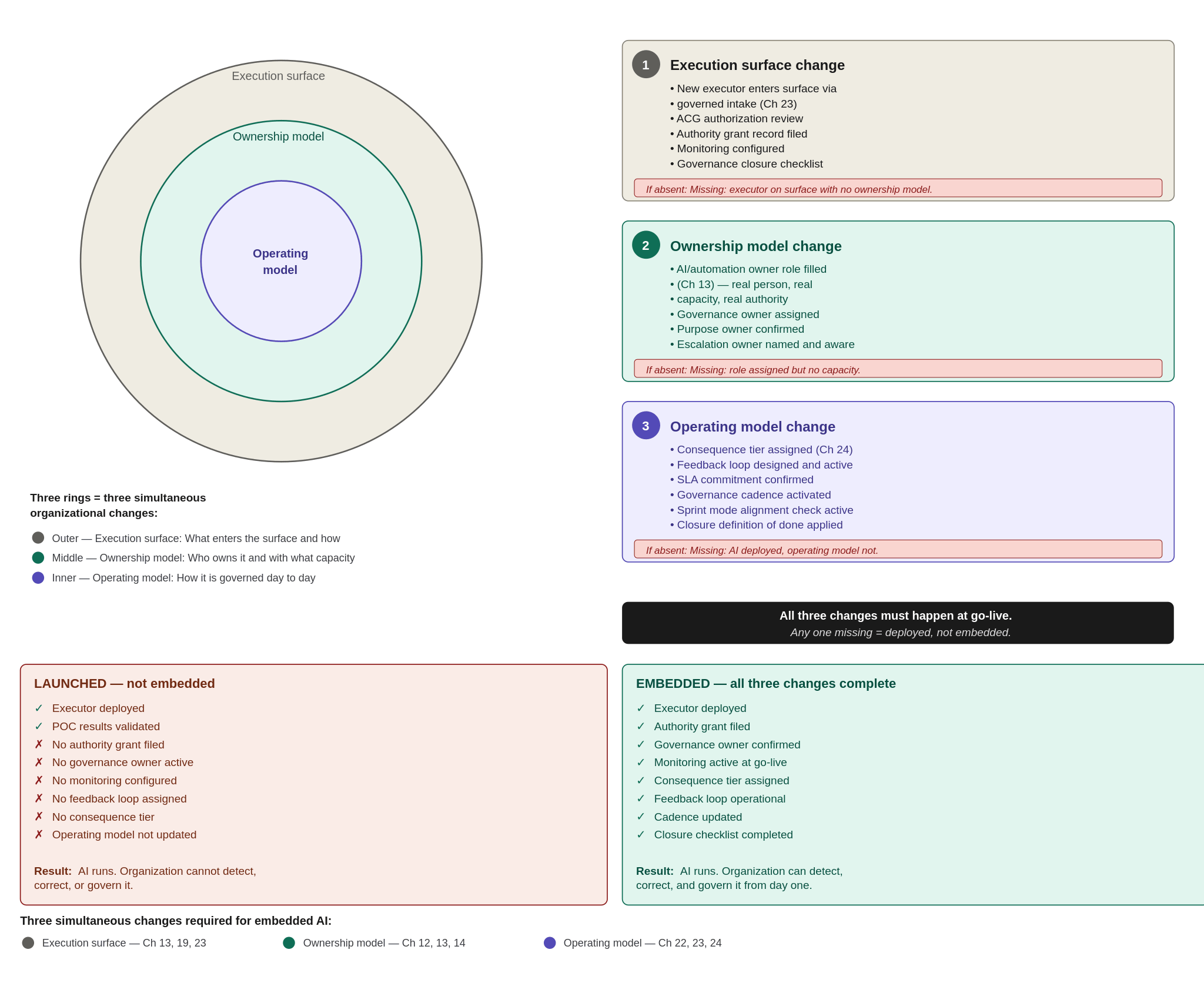
Three concentric rings represent the three required organizational changes. All three must be complete at go-live — not sequentially. Left: what each change requires and its absence failure mode. Right: the difference between launched (executor running, no governance infrastructure) and embedded (all three changes complete from day one).
WHY ORGANIZATIONS SEQUENCE WHAT MUST BE SIMULTANEOUS
The sequencing pattern is not irrational. It reflects how AI initiatives are structured. The team that builds the AI is typically a product or engineering team whose accountability is measured by deployment. The ACG review and the authority grant record are governance steps that add time to the deployment path. The ownership model roles are organizational assignments that require conversations with managers who are not on the product team. The operating model changes — updating the cadence, configuring the feedback loop, assigning a consequence tier — are governance activities that the deploying team typically has no mandate to initiate.
Each of these barriers produces the same response: deploy now, close the governance gap later. The deployment happens on schedule. The POC results were good. Leadership is satisfied. The governance work is planned for the next sprint, then the sprint after that, then deferred indefinitely as the team moves to the next initiative.
The structural correction is not to slow down deployment. It is to redefine what deployment means. An AI that is technically deployed but not governed is not finished — it is a liability disguised as delivery. The governance closure checklist from Chapter 23 and the consequence tier assignment from Chapter 24 are not post-deployment activities. They are deployment completion criteria. The work item does not close until all three organizational changes are complete.
THE EXECUTION SURFACE CHANGE: WHAT MOST ORGANIZATIONS DO
The execution surface change is the most visible of the three and the most likely to receive organizational attention. The ACG authorization review from Chapter 19 is a formal gate that the deploying team must pass. The authority grant record from Appendix D is a document that requires a named decision-maker. The governance closure checklist from Chapter 23 has five specific items that block the work item from closing.
Most organizations with a functioning ACG complete this change. The authorization review happens. The authority grant record is filed. The executor enters the surface with formal documentation of what it is authorized to do and under what conditions.
What the execution surface change does not complete on its own: it names a governance owner but does not confirm the owner has capacity. It defines monitoring thresholds but does not verify the monitoring is calibrated to a consequence tier SLA. It specifies an escalation surface but does not test whether the escalation path reaches an aware and available owner. The execution surface change establishes the structural requirements. The ownership model and operating model changes are what make those requirements real.
THE OWNERSHIP MODEL CHANGE: WHAT MOST ORGANIZATIONS BEGIN BUT DON'T COMPLETE
The ownership model change is the second of the three changes and the one most consistently left incomplete. The AI/automation owner role from Chapter 13 is assigned — but assigned to someone who is already carrying a full governance load across other executors. The governance owner from Part III is named in the authority grant record — but the name was provided under deadline pressure and the person named has not been briefed on their obligations. The escalation owner is recorded — but the system that routes escalations has the person's old Slack handle.
These are not failures of process. They are failures of capacity design. The ownership model for a newly deployed AI requires real people with real availability — not organizational chart entries. The governance owner must have the forty-five minutes per week from Chapter 24 for interpretation. The escalation owner for a Tier 1 or Tier 2 executor must be genuinely reachable within the SLA. The purpose owner must be actively engaged in the executor's output quality.
The specific failure is role assignment without capacity allocation. When a new executor is deployed and a governance owner is assigned, two things must happen simultaneously: the role is recorded in the authority grant record, and the time budget for the role is reflected in the owner's actual work commitments. In most organizations only the first happens. The owner is named. The forty-five weekly minutes are not protected. Within two sprints, the weekly monitoring session is the first thing dropped when delivery pressure is high. The ownership model change is nominally complete and operationally absent.
THE OPERATING MODEL CHANGE: WHAT MOST ORGANIZATIONS DEFER
The operating model change is the most frequently deferred of the three, because it is the least visible and the most distributed. It is not a single document to file or a single role to assign. It is a set of updates to the organization's ongoing governance practices — the cadence, the feedback loops, the prioritization model, the closure definition.
The cadence update from Chapter 22 means the new executor appears in the weekly governance owner monitoring session from day one. It means the executor's consequence tier determines which quarterly governance session agenda items are generated for it. It means the monthly review includes this executor's status in the execution surface health section. None of this requires new infrastructure — it requires updating existing practices to include the new executor.
The feedback loop design from Chapter 24 means the consequence tier is assigned before go-live, the loop type is determined, the SLA commitment is confirmed by the governance owner before deployment, and the monitoring model is calibrated to the tier's latency requirement. For a Tier 1 executor, this means confirming the on-call structure exists before the executor handles its first live decision — not after the first SLA breach surfaces the absence of a standby structure.
The sprint integration from Chapter 23 means the executor's governance work enters the team backlog with deadline-aware priority from the first sprint after deployment. The mode alignment check at the sprint retrospective includes this executor from the first sprint. The definition of done for any future work that touches this executor includes the governance closure checklist.
The operating model change is deferred because each of its components feels like it can wait. The cadence update can happen after the next sprint. The consequence tier can be assigned once the system proves stable. The feedback loop can be designed once there is monitoring data to calibrate against. Each deferral is individually defensible. Together they produce an executor that has been running for three months before the governance infrastructure that was supposed to govern it from day one is finally in place.
THE DEPLOYMENT JOURNEY: FROM INITIATIVE TO EMBEDDED
The three organizational changes do not happen in isolation — they happen in parallel, across five stages from initiative approval to embedded status. Each stage has specific activities, documents, people, and decisions for each of the three tracks. Understanding the full journey makes clear which activities can be done concurrently and which must happen in sequence within each track.
Figure: AI embedding journey — five stages across three parallel organizational change tracks
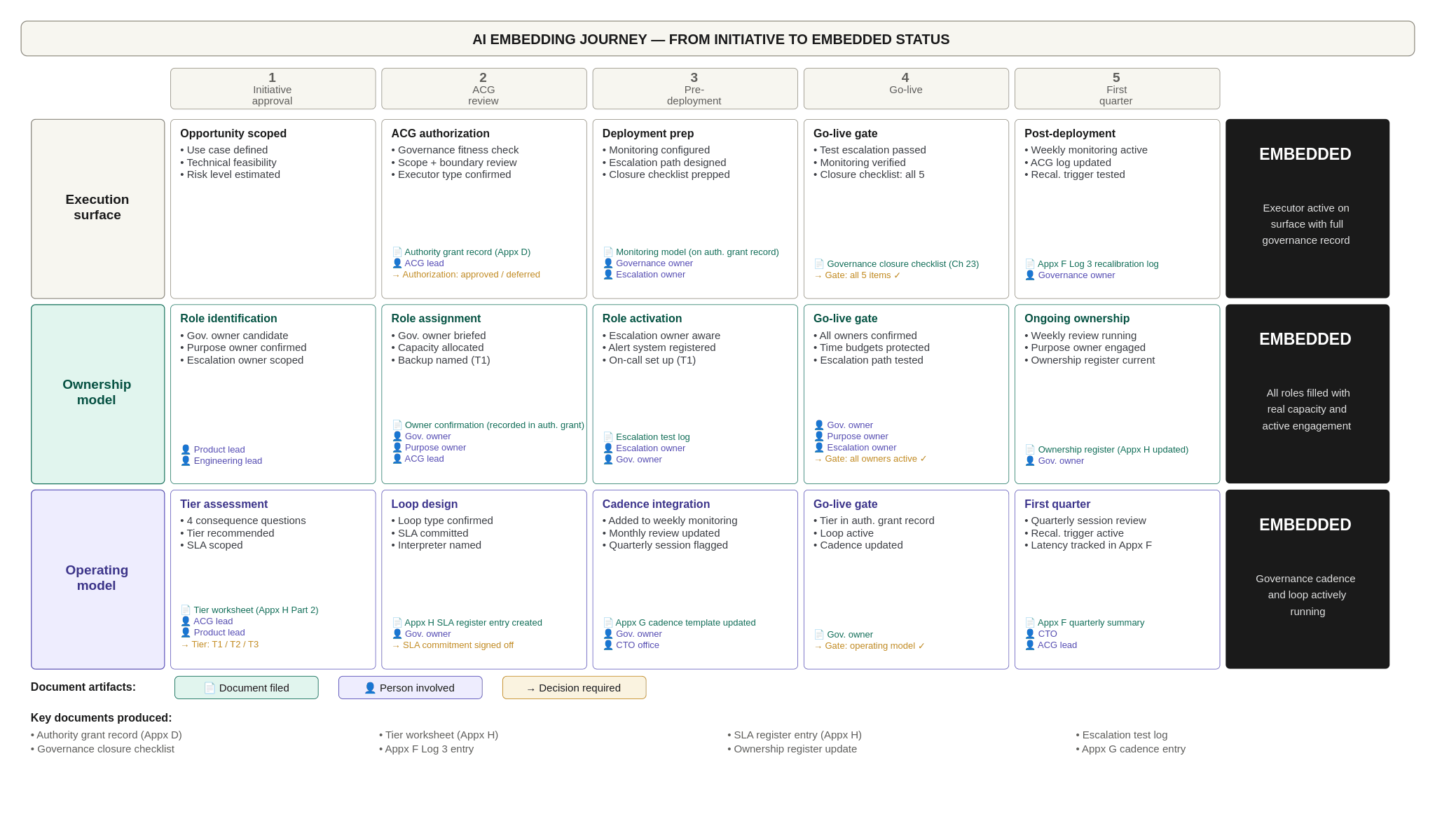
Three swim lanes (execution surface, ownership model, operating model) running across five stages. The EMBEDDED gate requires all three tracks to reach it simultaneously. Documents produced, people involved, and decisions required are called out at each stage. Post-gate: the ongoing governance state that makes the embedding permanent.
Several observations from the journey map are worth making explicit. First, the ownership model track begins at Stage 1 — initiative approval — not at Stage 3 (pre-deployment). Identifying the governance owner candidate and confirming the purpose owner happens before the ACG review, because the ACG review itself requires knowing who will own the executor after authorization. An organization that arrives at the ACG review without a named owner candidate is not ready for the review.
Second, the operating model track's consequence tier assessment also begins at Stage 1. The tier assessment from Appendix H requires the same consequence questions that the ACG review uses to evaluate governance fitness. Running them concurrently means the ACG review and the tier assignment happen at Stage 2 rather than having the tier deferred post-deployment.
Third, all three tracks have a go-live gate check at Stage 4. The embedded gate is not a single checkpoint — it is three parallel verifications that must all pass before the system goes live. The deployment readiness checklist provides the instrument for all three. Any single track failing its Stage 4 check blocks go-live for all three, because a system deployed with one track incomplete is launched, not embedded.
THE DEPLOYMENT READINESS CHECKLIST
The three changes converge at a single moment: the go-live gate. Embedding AI rather than launching it requires a deployment readiness standard that covers all three organizational changes — not just the technical deployment and the execution surface change. The following checklist is the minimum viable standard for a new AI executor to be considered embedded rather than merely deployed.
THE FAILURE MODE
The failure mode is the organization that has a functioning ACG, a completed authority grant record process, and a governance closure checklist — and still produces a backlog of launched-but-not-embedded executors. Every deployment passes the execution surface gate. Most deployments leave the ownership model and operating model changes incomplete.
The pattern is structural. The product team's definition of done includes the execution surface checklist. It does not include the ownership model confirmation or the operating model update — because those require action from people outside the product team and conversations that the delivery timeline did not budget for. The governance owner named in the authority grant record was informed by email. The consequence tier was not assigned because the person responsible for Appendix H was in a different organizational unit. The cadence update was the responsibility of the CTO's office and was not triggered by the deployment.
The correction is to make all three organizational changes the joint responsibility of the deploying team and the governance function at the moment of deployment — not sequentially, not as follow-up actions, but as conditions of the deployment being classified as complete. An executor whose consequence tier has not been assigned is not done. An executor whose governance owner has not confirmed their time budget is not done. An executor whose cadence has not been updated is not done. The deployment readiness checklist above is the instrument that makes this standard operational.