
Chapter 11: Scaling Without Headcount
Every organization that has grown past a certain size has experienced a version of the same conversation. Volume is increasing. Demand is growing. The business is working. And the answer to the question of how to keep up is almost always the same: hire more people.
This answer is not wrong. But in a hybrid organization, it is incomplete — and increasingly expensive. The assumption that capacity scales with headcount is the most costly legacy of human-centric organizational design. It treats every increase in volume as a people problem, when a significant portion of it is a design problem.
Scale is a design choice. Not in the aspirational sense — not as a statement about what technology could theoretically enable — but as a structural claim about how organizations are built. An organization designed to scale through headcount will scale through headcount. An organization designed to scale through system absorption will bend the cost curve as volume grows. The difference is not the technology available to both. It is the organizational design that determines how that technology is deployed.
This chapter is about what that design looks like, how it works, and what it requires.
THE CORE IDEA
In a traditional organization, the relationship between volume and cost is linear. More transactions require more people to process them. More customers require more engineers to serve them. More complexity requires more managers to coordinate it. The cost curve rises with the output curve, and the margin remains structurally stable as scale increases.
In a hybrid organization, this relationship can be broken. Not automatically, and not by deploying technology. It is broken by deliberate organizational design that routes an increasing proportion of volume through the automated execution layer rather than through the human layer.
The mechanism has three components.
Marginal cost decoupling. When a new unit of work is processed by an automated system rather than a human, its marginal cost becomes negligible relative to human execution. A data pipeline that processes one thousand transactions per day costs approximately the same to run at one hundred thousand. A CI/CD pipeline that validates one commit costs approximately the same at one million. A fraud detection model that evaluates one transaction costs approximately the same at ten million. The fixed cost of building and governing the system is real. The marginal cost of each additional unit of work processed by that system is not.
Work disappearance. When a workflow is automated well, the human effort it previously required does not simply transfer elsewhere — it disappears. An analyst team that spent forty hours per week generating a weekly report is not freed to do forty hours of other work when the report is automated. The forty hours of report-generation work ceases to exist as a human capacity demand. The team's capacity either shrinks by the equivalent amount, or it shifts to work that requires human judgment — design, analysis, interpretation, governance — rather than execution. When organizations fail to recognize this as work disappearance rather than work transfer, they undercount the capacity impact of automation and underinvest in it accordingly.
System absorption of effort. Over time, in a well-designed hybrid organization, the automated execution layer absorbs an increasing proportion of total execution effort. New workflows that would previously have required human staffing are designed for system-led or fully automated execution from the outset. Existing workflows migrate from human-led to human-assisted, and from human-assisted to system-led, as the maturity of the systems and the organization's governance capability increases. The human layer concentrates progressively on higher-judgment work — the work that creates the most organizational value and that systems cannot perform.
Together, these three components produce a cost curve that flattens as volume grows — not because the organization is cutting costs, but because the organizational design is routing volume to the execution layer that handles it most efficiently.
WHAT THIS LOOKS LIKE
Two technology companies are both scaling their customer support operations. Both have a base of five hundred support engineers handling an incoming volume of fifty thousand support queries per day. Both are growing at thirty percent per year. At that growth rate, their query volume will reach two hundred thousand per day in four years.
The first company scales through headcount. Its organizational design treats customer support as a human function — queries are routed to engineers, engineers resolve them, resolution requires human judgment at every stage. As volume grows, the company hires proportionally. By year four, it has two thousand support engineers handling two hundred thousand queries per day. The cost base has scaled linearly with volume. The margin on support operations is approximately the same as it was at fifty thousand queries per day.
The second company redesigns its execution surface before scaling. It identifies that approximately sixty percent of incoming queries fall into categories that can be resolved by an AI agent operating in system-led mode — with a well-designed escalation path to a human for edge cases. It invests in building and governing that AI layer during year one. By year two, the AI layer is handling sixty percent of query volume. The human engineers handle the remaining forty percent — the complex cases, the escalations, and the cases the AI cannot confidently resolve. As volume grows, the AI layer absorbs the growth proportionally. By year four, the company has eight hundred support engineers handling eighty thousand queries per day — the forty percent of two hundred thousand that genuinely requires human judgment. The cost base has grown, but not linearly. The gap between revenue growth and cost growth has widened.
The technology available to both companies is identical. The difference is organizational design. The first company designed for human-centric execution. The second designed for hybrid execution. Scale is a design choice — and the second company made it.
Figure: Cost curve comparison — headcount-led vs hybrid execution (indexed, year 0 = 100)
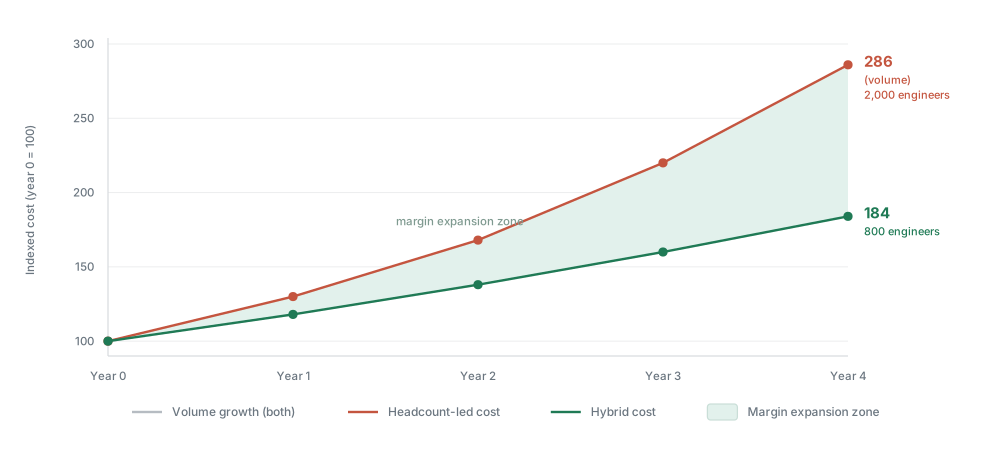
Both organizations face identical volume growth. The margin expansion zone represents the compounding difference in cost structure — wider each year as the hybrid execution layer absorbs increasing share of volume.
THE DESIGN DECISIONS THAT DETERMINE THE CURVE
The second company's outcome is not the result of automation alone. It is the result of a set of design decisions that determine how automation is introduced, governed, and scaled. The cost curve does not flatten automatically in a hybrid organization. It flattens when a specific set of organizational design decisions are made correctly and maintained over time. Three decisions are determinative.
The execution mode decision at workflow inception. Every new workflow the organization builds or adopts should have an explicit execution mode assigned at the point of inception — not retrofitted after the workflow has been operating in human-led mode for two years. A workflow designed for system-led execution from the outset will absorb volume without proportional human cost growth. A workflow designed for human-led execution and later automated will absorb volume only after significant redesign effort. The earlier the execution mode decision is made correctly, the more volume is absorbed at near-zero marginal cost over the life of the workflow.
The migration cadence for existing workflows. An organization that designs new workflows for hybrid execution but never migrates existing human-led workflows will achieve partial curve flattening at best. The full impact requires a deliberate, ongoing process of reviewing human-led workflows against the four execution modes and asking: is this workflow still correctly positioned, or has the maturity of the relevant systems and the organization's governance capability reached the point where a migration to human-assisted or system-led execution is justified? This is not a one-time exercise. It is a permanent design discipline.
The platform investment decision. Neither the execution mode decision nor the migration cadence can be executed well without the platform infrastructure to support them. An organization that makes correct execution mode decisions but lacks the deployment infrastructure, observability tooling, and governance framework to operate those modes effectively will find that its automated workflows are ungoverned, unreliable, or impossible to migrate safely. The platform is the precondition for scaling without headcount — which is why the investment logic in Chapter 9 connects directly to the scaling logic in this chapter.
THE FAILURE MODE
The failure mode specific to scaling without headcount is not failing to automate. Most organizations automate extensively. The failure mode is automating without designing — deploying systems that absorb volume without the governance model, ownership structure, or migration discipline that makes the absorption durable and compounding.
The symptoms are familiar. An organization deploys significant automation over several years. The cost curve does not visibly flatten. Leadership asks why the AI and automation investment is not showing up in the margin. The answer is almost always the same: the automation is running, but it is not well-governed; the human layer has not been reduced or reallocated; the workflows were automated but not redesigned; the platform is not providing the shared governance infrastructure that would make each new automation composable rather than reconstructive.
The automation is not the problem. The organizational design around the automation is the problem. Systems that absorb effort without a governance model do not produce durable cost reduction — they produce operational risk that eventually requires human intervention to manage, consuming the capacity the automation was supposed to free.
A second failure mode is confusing automation investment with headcount avoidance. The goal of scaling without headcount is not to reduce the human layer — it is to prevent the human layer from growing proportionally with volume, while concentrating human capacity on the work that creates the most value. Organizations that treat automation as a tool for cutting existing headcount rather than absorbing future volume tend to underinvest in governance, creating the ungoverned execution surface that produces the first failure mode. The human layer and the automated layer are not in competition. They are co-executors. Designing them as adversaries produces neither the cost curve nor the organizational health that hybrid execution requires.
THE STRUCTURAL CORRECTION
First: treat automation as a capacity asset, not a cost reduction lever. Automation absorbs effort. The absorbed effort represents real organizational capacity — capacity that either allows the organization to grow without proportional hiring, or allows existing human capacity to shift to higher-value work. Both outcomes are valuable. Neither is captured by a headcount reduction model. The capacity accounting model from Chapter 8 — where team capacity is measured against the full execution surface, not just headcount — is the mechanism for making this visible. Without it, automation investment is measured against the wrong benchmark and chronically undervalued.
Second: design every significant workflow for its long-term execution mode, not its current one. A workflow that is human-led today because the system is immature should be designed with its target execution mode in mind — the mode it will operate in when the relevant systems are mature and the governance model is established. That target mode shapes the platform infrastructure required, the ownership model assigned, and the monitoring designed. Organizations that design only for today's execution mode rebuild everything when the mode changes. Organizations that design for the target mode migrate incrementally.
Third: make execution mode migration a first-class organizational process. The migration of workflows from human-led to human-assisted, or from human-assisted to system-led, should be a recognized, structured activity with ownership, criteria, and a governance review at each transition. It should not be an informal decision made by an individual team. The criteria for migration — system maturity, governance model readiness, escalation path design — should be defined by the automation capability group and applied consistently. The migrations, when they happen, should appear in the capacity accounting model as the capacity expansions they are.