
Chapter 21: Decision Latency as a First-Class Organizational Metric
Chapters 17 through 20 built the decision architecture for a hybrid organization: the right decision types, the right processes, the right authority distribution, the right permanent boundaries. A CTO who has implemented this architecture correctly has the governance model the execution surface requires.
Chapters 17 through 20 define the decision architecture. This chapter tests whether that architecture is functioning in practice — not whether it exists, but whether it produces decisions.
An organization can have every process correctly designed — ACG reviews in place, dual-ownership protocols established, authority grants documented, permanent boundaries defined — and still have a governance model that is not functioning. Because the processes exist on paper but decisions take too long. Or because certain decision types are never being made at all. Or because speed signals that are too fast in one category are masking inadequate deliberation, while too-slow signals in another are masking avoidance.
Decision latency is the metric that surfaces this gap. Not as a KPI for the governance function, and not as an operational efficiency measure. As a structural health signal: a diagnostic that reveals whether the decision architecture is producing decisions at the right speed, at the right level, with the right accountability — or whether it has become a formal structure with informal workarounds accumulating around it.
THE CORE IDEA: LATENCY AS DIAGNOSTIC
Each of the four decision types from Chapter 17 has an appropriate latency profile — a range within which the decision should be made, calibrated to the consequence of the decision, the organizational level at which it sits, and the operational cost of delay. Deviation from the appropriate range in either direction is a governance signal.
This is the critical point that distinguishes decision latency from a simple speed metric: the signal runs in both directions, and it runs differently for different decision types.
High latency on authorization decisions signals governance bottleneck — the review process has become slower than the organization's deployment pace, and teams are beginning to route around it. But low latency on delegation decisions signals something equally concerning: strategic decisions about the scope of automated authority are being made without adequate deliberation. Low latency here is not efficiency. It is a sign that consequential authority grants are being made too quickly for the accountability they require.
And for certain decision types — model-level decisions most prominently — the most dangerous signal is not high latency or low latency. It is zero activity. An organization that has made no model-level decisions about its execution surface in twelve months has not decided that its execution model is correct and requires no changes. It has simply not looked. The execution surface is evolving through individual authorization and recalibration decisions without the strategic frame that model-level decisions are supposed to provide. This is absent governance — not slow governance, not fast governance, but no governance at all on the dimension that matters most strategically.
Figure: Decision latency profile — appropriate ranges and governance signals by decision type
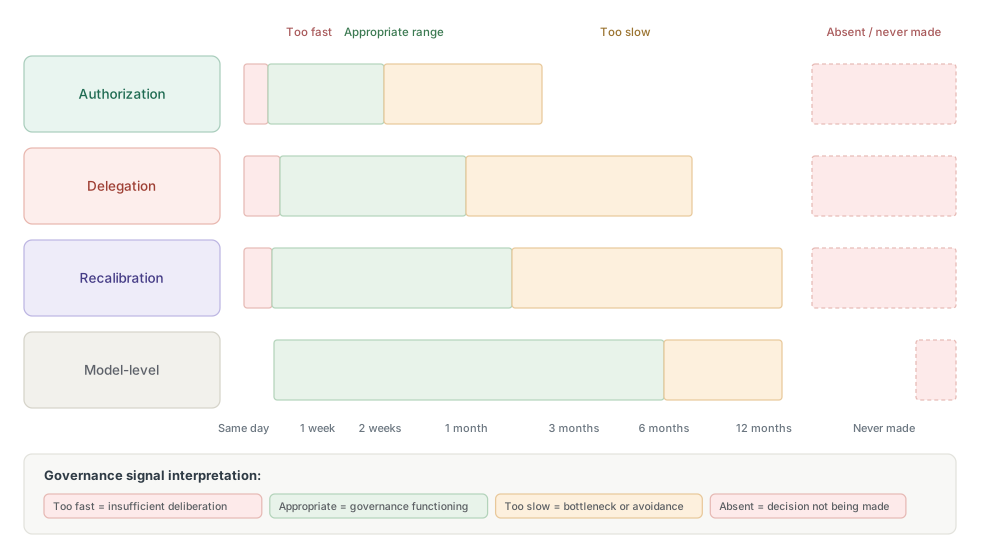
The signal runs in both directions. Too fast signals insufficient deliberation. Too slow signals bottleneck or avoidance. Absent signals the decision is not being made. Model-level decisions have no 'too fast' zone — the risk is always delay or absence, never excessive speed.
THE LATENCY PROFILE FOR EACH DECISION TYPE
Authorization decisions should resolve within days for routine deployments and within one to two weeks for high-consequence deployments requiring full ACG review. Authorization is a gatekeeping decision — it should not be slow enough to become a bottleneck, but it must be substantive enough to be meaningful. Latency above two weeks for routine deployments signals that the ACG process has become over-centralized or under-resourced. Latency below twenty-four hours for high-consequence deployments signals that the review is not substantive — approvals are being rubber-stamped rather than genuinely reviewed. Absent authorization latency means the decision is not being made at all: executors are entering the execution surface without governance review, which is the deployment-without-authorization failure mode from Chapter 19. The ACG owns authorization latency within the process. The CTO owns the decision when latency signals that the process itself requires redesign — expanding ACG capacity, adjusting the self-certification threshold, or restructuring the review scope. The ACG cannot fix its own resource constraint.
Delegation decisions should resolve within one to four weeks following a structured leadership review. Delegation decisions are deliberately slow — the organization is deciding how far authority travels into systems, which is consequential and difficult to reverse quickly. Latency below a week is a signal that insufficient deliberation is happening: decisions about automated authority scope are being made at the same pace as operational decisions. Latency above six weeks signals that the decision is being avoided rather than made — which is how consequential authority accumulates in systems by default rather than by design. Absent delegation decisions, over any significant period, means authority has never been explicitly granted: the organization has automation but not governed delegation. Delegation latency is owned unconditionally by the CTO and senior leadership. It cannot be attributed to the ACG, to governance owners, or to the product organization. Absent delegation decisions are a leadership accountability failure.
Recalibration decisions should be triggered by monitoring signals and supported by a defined review cadence as a backstop — not the reverse. The monitoring signal is the primary trigger: a behavioral drift alert, a purpose owner's observation that outcomes are diverging, a change in the conditions the executor was calibrated for. The cadence is the safety net that catches recalibrations that should have been triggered but were not — the quarterly review that asks whether any executor has not been assessed in the past period. Zero recalibration activity over a twelve-month period is the most significant latency signal in this category: it almost never reflects a perfectly calibrated execution surface. It reflects an ownership model that is not actively functioning — governance owners and purpose owners who are not initiating reviews, monitoring that is not surfacing signals, or a recalibration protocol that exists on paper but has never been exercised. When recalibration activity is zero, the execution surface is aging. Executors are making decisions about conditions that may have changed substantially since their parameters were set. The governance owner and purpose owner are jointly accountable for recalibration activity on each executor. Zero activity organization-wide is a signal for the CTO — it indicates the ownership model is not functioning as a system, not merely that individual pairs have been inactive.
Model-level decisions should occur on a defined cadence — quarterly or annual — with clear documentation of what was decided and why. There is no 'too fast' zone for model-level decisions: the risk is always delay or absence, never excessive speed. An organization that has not made an explicit model-level decision about its execution surface in over twelve months has not decided that its execution model is correct. It has deferred the decision. The individual authorization, delegation, and recalibration decisions that accumulate in the absence of model-level governance will produce an execution surface that reflects their individual logic but not any coherent strategic direction. The surface evolves. The strategy does not. Model-level latency is owned unconditionally by the CTO. It is the one decision type that cannot be delegated, attributed to governance owners, or explained by process constraints. Absent model-level decisions are a CTO accountability failure — visible directly at board level.
THE BOARD-LEVEL SIGNAL
Decision latency is a board-level signal because it measures the organization's ability to govern a strategic asset — the execution surface — in real time. Most board-level governance reporting focuses on what the execution surface has done: business performance, risk incidents, regulatory compliance. These are lagging indicators. Decision latency is a leading indicator. It measures whether the organization is maintaining the control architecture necessary to govern what the execution surface will do.
An organization whose authorization latency has tripled over the past year is an organization whose governance model cannot keep pace with its deployment rate. The business performance metrics may look acceptable. The decision latency signal reveals that the governance architecture is under structural strain before the strain manifests in outcomes.
Three latency patterns warrant board visibility.
Sustained high authorization latency — consistently more than twice the established target — signals that the ACG process is under-resourced or incorrectly designed for the organization's current scale. If governance cannot keep pace with deployment, one of two things is happening: the organization is deploying faster than its governance model can support, or teams have begun routing around the process and only the cases that cannot be avoided are reaching the ACG. Either pattern is a board-level governance concern.
Absent recalibration activity — no recalibration decisions across consequential executor classes over a twelve-month period — signals that the ownership model is dormant. The execution surface is aging on stale parameters. The board should understand that its execution surface is making decisions calibrated for conditions that existed twelve months ago, with no active governance process refreshing them.
Absent model-level decisions — no documented strategic decisions about the execution surface over a twelve-month period — signals that the organization is not actively governing its execution model at the strategic level. The execution surface is evolving by default. This is the most significant board-level governance signal, because it means the organization cannot answer the fundamental question: is the execution surface we have the one we designed and intend to operate?
REPORTING DECISION LATENCY TO THE BOARD
The board receives decision latency as a governance health report — a leading indicator of whether the organization retains strategic control of its execution surface. It is not an operational performance report. The board does not need to understand the mechanics of authorization reviews or recalibration protocols. It needs to understand whether the governance architecture is functioning, where it is under strain, and who is accountable for the correction.
The report has four elements for each decision type: the current latency, the signal it represents, the named accountable party, and the correction status. A board that receives this structure can ask the right questions without requiring a detailed briefing on the governance model.
| Decision type | Current latency | Signal | Accountable party | Correction status |
|---|---|---|---|---|
| Authorization | 3 days average (target: 2 days). Trending up — 60% increase over prior quarter. | ACG process under capacity pressure. Teams beginning to submit early to manage queue. | ACG lead (process). CTO (if process redesign required). | ACG capacity review underway. Proposal for expanded self-certification by [date]. |
| Delegation | 2 decisions in past 12 months (target: as required by deployment pipeline). No absent decisions. | Within appropriate range. No signal of avoidance or insufficient deliberation. | CTO and senior leadership. | No correction required. Next review at quarterly model-level session. |
| Recalibration | 4 decisions in past 12 months across 41 executors. 37 executors with no recalibration activity. | Ownership model likely dormant for majority of execution surface. Requires investigation. | Governance owners and purpose owners per executor. CTO owns organization-wide pattern. | Investigation initiated. Findings due [date]. Root cause likely monitoring configuration gap. |
| Model-level | Last documented decision: [date] — 14 months ago. Zero activity since. | Model-level governance has lapsed. Execution surface evolving without strategic frame. | CTO — unconditional accountability. | Quarterly model-level review scheduled for [date]. Prior to that: interim review of execution surface growth since last decision. |
THE MEASUREMENT INFRASTRUCTURE
Decision latency is only a useful diagnostic if the data exists to compute it. The CTO does not discover that authorization latency has grown from three days to twenty-two days by intuition — she discovers it because a date-stamped log makes the trend visible. Without tracking infrastructure, latency signals are invisible until they produce failures.
The tracking instrument is not a new system. It is a structured extension of the ACG governance library established in Chapter 13 — adding date fields, producing a quarterly summary, and making trends visible to the CTO before they reach the board. The ACG owns the register. The CTO reviews the quarterly summary. The board receives the report.
Each decision type requires a different tracking structure, because the latency calculation and the meaningful signal are different for each.
WHAT THIS LOOKS LIKE
DECISION LATENCY AND CHAPTER 18'S DISTRIBUTION QUESTION
Chapter 18 established that the distribution of decision authority across organizational levels is an active design variable — something the CTO must shape and maintain as the organization grows. Decision latency is the observable proxy for whether that distribution is working.
The CTO cannot directly see whether authority is sitting at the right level. She can see whether decisions are being made at an appropriate speed. Latency is the measurement that makes distribution health visible without requiring a full governance audit.
When authorization latency rises sharply after a period of organizational growth, the distribution has drifted: authority is too concentrated at the center and the center cannot handle the volume. When delegation decisions stop being made, authority is drifting into systems by default rather than by design. When recalibration activity disappears, the distributed ownership model has become nominally distributed but practically dormant. When model-level decisions are absent, the strategic frame has been abandoned and the distribution is operating without direction.
Latency monitoring is therefore not a separate governance instrument — it is the feedback mechanism for the distribution design. An organization that measures and responds to decision latency is actively maintaining its decision architecture. An organization that does not is discovering distribution failures only when they produce outcomes failures.
THE FAILURE MODE
Two failure modes, representing opposite ends of the latency problem.
The frozen governance model — where authorization latency is so high that deployment velocity has outpaced governance capacity, recalibration activity is near zero because the ownership model is under-resourced, and model-level decisions have lapsed to annual at best. The execution surface grows faster than the governance model can track. Individual decisions are technically compliant — they pass through the right process — but the process is too slow to be substantive and too infrequent to be current. The organization has governance infrastructure that is no longer governing.
The absent governance model — where certain decision types have effectively infinite latency because they are not being made. No delegation decisions are documented because authority has accumulated through deployment. No model-level decisions are recorded because no one has claimed ownership of the strategic frame. No recalibration activity exists because the ownership model was built but never activated. The infrastructure exists. The decisions it was designed to produce do not.
Both failure modes share a common diagnostic: decision latency reveals what the governance architecture cannot. An organization can have well-designed processes, correct ownership assignments, and appropriate authority distribution — and still have a governance model that is not producing the decisions it was designed to produce. Latency is the measurement that makes this gap visible before it produces a failure.