
Appendix I - One Initiative, All Surfaces: A Threaded Example
This appendix walks a single initiative through the structural surfaces the book has developed. Its purpose is not to exhaustively apply every chapter. Its purpose is to show how the surfaces compose in practice, so the reader can see the book’s layers operating together rather than as separate disciplines.
The example is specific. That specificity is the point. Abstract examples produce abstract learning. This one is grounded enough that the reader can test whether the book’s frameworks actually hold when the details push back.
The organization
A mid-market omnichannel specialty retailer. Approximately 2,500 employees. Around 200 stores plus an e-commerce channel that now represents 35% of revenue and is growing. Annual revenue approximately $900 million. Category is specialty apparel — mid-price, high SKU count, seasonality that matters, margin under sustained pressure from direct-to-consumer brands and large marketplaces.
The organization has an existing technology organization of approximately 180 people led by a CTO who has been in role for three years. Existing engineering teams support e-commerce, point-of-sale, merchandising systems, planning and allocation systems, supply chain visibility, and a growing data and analytics function. There is no existing ACG; model governance has been handled informally by a small data science team sitting under the CTO.
The operational organization is led by a COO with long retail experience. The merchandising organization is led by a Chief Merchandising Officer (CMO) who owns the product assortment, pricing calendar, markdown strategy, and vendor relationships. The CMO and COO both report to the CEO alongside the CTO and CFO. There is no Chief Product Officer in the SaaS sense; in retail, the CMO holds the product-owner role for the assortment.
This is the organization that will install the initiative described below.
The initiative
The initiative is the installation of an AI-powered markdown and replenishment capability into the existing merchandising and planning workflow.
Currently: merchandisers set markdowns manually, guided by sell-through reports and experience. Planners reallocate inventory across stores manually, guided by weekly demand signals and allocation rules. These are the two highest-volume operational decisions in the organization — tens of thousands of SKU-location-week combinations per week — and they are made by human judgment applied to partially structured data.
Proposed: an AI capability that makes the majority of markdown and replenishment decisions within defined guardrails. Exceptions — high-value SKUs, brand-sensitive categories, cross-season transitions, promotional calendar conflicts — escalate to human judgment. The capability is a procured model with a significant custom-tuning layer; it is not a pure build.
The business case is concrete. A 2-3% gross margin lift from markdown optimization and a 5-8% reduction in inventory carrying cost at equivalent sell-through. On $900M revenue with ~45% gross margin, the margin lift alone is worth $5-8M of gross profit annually, against an implementation investment of approximately $3M in year one and $1M ongoing. The payback is under a year on the margin side.
This is the initiative. The rest of this appendix shows how it moves through the book’s structural surfaces.
The moment of installation is the moment the organization stops being a human-executed workflow with technology support and becomes a hybrid-executed workflow governed as a system. That transition is structural, not technical — and every surface the book develops becomes active at the moment it happens.
Surface 1 — The execution surface (Parts I and II)
The first structural question is not what will the AI do. It is what does the execution surface look like after installation, and how does that differ from the execution surface today.
Today’s execution surface for markdowns and replenishment is almost entirely human-led. A merchandiser reviews a report, forms a view, enters a decision into a system. A planner reviews an allocation, adjusts, approves. The system records; the human decides.
The installed execution surface is different. Markdown decisions split into four execution modes:
• Fully automated for routine SKU-week-store markdown adjustments within a defined band (for example, ±15% markdown on SKUs with normal-season classification and no brand-sensitivity flag). No human touches any individual decision. The system decides, executes, and logs.
• System-led for markdown decisions outside the automated band but within the model’s confidence range. The system proposes, a named merchandiser reviews and can accept, reject, or adjust within a defined window. Individual exceptions route to the human; the default is the system’s decision.
• Human-assisted for markdowns on flagged categories (new brands, seasonal transitions, key items). The system provides the analysis and recommendation; the merchandiser makes the decision.
• Human-led for strategic pricing decisions — entry pricing for new assortments, promotional calendar alignment, competitive response to specific events. The system informs but does not decide.
This matters because the execution surface is now substantially larger than it was. It used to be "the merchandiser’s work." It is now four distinct execution modes with different ownership, different cadences, and different failure modes. The organization that treats this as "we installed an AI tool for markdowns" will operate blind to most of what has actually changed.
The book’s Chapter 2 test applies here: what does the organization execute, as distinct from what it produces? The organization produces the same thing — an apparel assortment, priced and allocated. What it executes is now four different things instead of one.
Surface 2 — Ownership (Part III)
Three ownership questions surface immediately once the execution surface is drawn.
Who owns the model? The model makes decisions that used to be owned by merchandisers. The merchandisers did not build the model, cannot modify it, and in many cases cannot fully explain its behavior on specific SKUs. Is the CMO the owner of the model’s outputs because the CMO owns merchandising outcomes? Is the CTO the owner because the model is a technology asset? Is neither, because ownership is undefined and the first time something goes wrong the answer will be discovered in a crisis?
The book’s answer, from Chapter 12 and the attribute-level ownership framework: ownership is split by attribute. The CTO (through the ACG) owns the model’s technical behavior — its drift, its calibration, its error profile, its operational health. The CMO owns the model’s decisions — whether the markdown strategy it produces is the markdown strategy the organization wants. Both ownership grants are formal, both are recorded, both have named decision-makers. Neither is informal.
This is not a minor clarification. It is the structural move that makes the rest of the installation governable.
Who owns the data? The model’s decisions are only as good as the data it consumes. Sell-through data quality belongs to the planning function. Brand-sensitivity flags belong to merchandising. SKU classification belongs to the merchandising systems team. Before the model is installed, all three of these are adequate for human decision-making because humans fill the gaps with context. After installation, the model cannot fill gaps with context; it will act on bad data as though it were good data. The ownership of each data attribute becomes a formal grant, not a shared assumption.
Who owns the exceptions? The model will produce outputs that get flagged for human review. Who is accountable for reviewing them, in what cadence, with what failure mode if the review is not done? In retail, the answer is never "the merchandiser whenever they get to it." That is how exceptions pile up, SLAs silently break, and the model’s governance becomes a backlog.
Surface 3 — Decision architecture (Part IV)
The installation forces a decision-type classification that the organization has never had to make explicit.
For every category of markdown decision, the organization has to answer: what type of decision is this? Chapter 17’s taxonomy becomes immediately operational:
• Reversible vs. irreversible — most markdown decisions are reversible (can be re-marked up) but once inventory has moved to a store or a customer has bought, reversal is harder.
• High-information vs. low-information — some markdown decisions are straightforward given the data; others require context the system does not have.
• Individual vs. systemic — individual markdown decisions do not shape the organization’s future; aggregate markdown strategy does.
The book’s Chapter 19 question applies: when the system decides, under what authority does it decide, with what boundaries, and with what named escalation path when the boundaries are approached? In the installed state, every automated markdown decision runs under a formal authority grant — scope, bounds, revocation conditions, named escalation. Without that grant, the organization has handed decision authority to an artifact whose authority is undefined.
Chapter 20’s permanent-human-judgment policy also applies. Some markdown decisions must be made by a named human regardless of what the model recommends — for example, markdowns on items that carry brand-signaling weight, or markdowns during a specific promotional window the CMO has reserved. The policy names these explicitly. The model does not learn around them; the model does not touch them.
The organization that installs the capability without this classification work will spend the next eighteen months discovering the classification one incident at a time.
Surface 4 — Operating model (Part V)
The installation changes the operating cadence. Before: weekly markdown review meeting, monthly strategic pricing review, quarterly planning cycle. After: the weekly markdown review meeting no longer reviews markdowns — the model has made them. It now reviews the model’s behavior — hit rates, exception volumes, drift signals, categories where the model is underperforming.
This is the Chapter 24 feedback loop redesign. The organization has to install a cadence that did not previously exist: the ACG-led weekly review of the model’s operational behavior, with the CMO’s team present to assess whether the model’s decisions match the strategy. The merchandisers who used to make the decisions now evaluate the decisions. This is a different capability and a different weekly rhythm.
The Chapter 25 lesson also applies: the AI capability is not launched — it is installed in a specific operational context with a specific governance surface around it. A launch implies a finish date; an installation implies an ongoing governance responsibility. The difference is not semantic. The finance plan, the headcount plan, and the success metrics all change based on which framing the organization adopts.
Surface 5 — Economics (Part VI)
The economics of the initiative look clean on the surface: $5-8M margin lift, $3M implementation, $1M ongoing. Year-one payback.
Parts VI and VII of the book make this more precise, and the precision matters.
The $3M implementation is not a single investment. It is the fully-loaded cost of model procurement, custom tuning, data quality remediation, ACG buildout, exception handling workflow redesign, and the weekly governance cadence design. The book’s Chapter 29 lesson applies: investment concentrates in the governance surface around the model, not in the model itself. An organization that budgets for "the AI project" and not for the governance infrastructure will systematically under-resource the installation and blame the model when the outcomes disappoint.
The $1M ongoing is similarly not a maintenance fee. It includes the ACG’s operational cost, model retraining cycles, data quality governance, exception handling capacity, and the cadence overhead for weekly and quarterly review. The book’s Chapter 27 unit economics shift applies: the labor cost per markdown decision collapses from dollars to cents, but the governance cost per model-making-markdowns is a new line item that did not exist before and is not small.
The $5-8M margin lift is achievable but conditional. It assumes the model is operating within its intended band, data quality holds, exceptions are handled on cadence, and the organization’s incentive structure does not push against the model’s decisions. If any of those conditions degrade, the margin lift degrades with them. The economics are real but they are not automatic.
The Chapter 31 lesson — making the case to leadership — applies here too. The CFO will accept the business case at face value only until the first quarter where the model makes a decision that feels wrong in retrospect. The case that survives contact with operational reality is not "this saves money" but "this saves money if we install and maintain the governance infrastructure around it, and here is what that infrastructure specifically looks like." The second framing is harder to sell. It is also the one that survives.
Surface 6 — Leadership alignment (Part VII)
The installation requires three peer executives to operate differently, and the CTO’s job is to translate the change into each of their decision frames.
The CMO (Chapter 33’s role in this organization, as the product-owner equivalent). The CMO is ceding decision authority over tens of thousands of weekly markdown decisions to a system. The CMO is simultaneously gaining a new capability: the ability to govern markdown strategy at a level of precision that manual markdown-making never permitted. The translation the CTO owes the CMO is: you are not losing markdown authority; you are moving markdown authority up a level. You govern the strategy, the system executes the strategy, and you review the system’s execution against the strategy you set. The work is different. The authority is sharper.
The COO (Chapter 32). The COO owns operational execution across stores and distribution. The COO’s teams live downstream of markdown decisions — store associates receive the markdowns, execute the tag changes, handle customer reactions. The COO is not directly affected by who makes the markdown decision; the COO is directly affected by whether the downstream operational load changes. The translation the CTO owes the COO is: the volume of markdown communications to stores will shift from weekly batches reviewed by humans to continuous adjustments made by the system. Your store operations teams need different inbound information cadences. Here is what needs to change in the store communications rhythm.
The CFO. The CFO is the executive whose frame most directly shapes whether the installation succeeds as an organizational change, because the CFO controls the budget and the measurement. The translation the CTO owes the CFO is: the return on this investment does not live in year one; it lives in years two and three. Year one is installation cost; year two is when governance infrastructure reaches steady state; year three is when the model’s drift-and-retraining cycle produces sustained margin lift. The business case that treats year one as the payback window will cause the organization to under-invest in governance and collect less than half the available return.
These three translations are not communication tasks. They are structural conditions on the initiative succeeding. Without them, each peer executive holds a different (incorrect) mental model of what the installation is doing, and the resulting misalignment degrades the installation in ways that are invisible until the first quarter review.
Surface 7 — The model under pressure (Part VIII, Chapter 39)
Six months after installation, the model is operating. The margin lift is tracking ahead of plan. The ACG cadence is running. And the initiative is in trouble, because of the surface the book’s Chapter 39 addresses: conflicting incentives.
The compensation structure of the merchandising organization has not changed. Merchandisers are compensated on gross margin dollars in their category. The AI-driven markdown strategy optimizes for total gross margin across the assortment, which sometimes means taking deeper markdowns in one category to clear inventory that would otherwise block receipts of higher-margin items. For the category merchandiser, this shows up as a compensation hit — their individual category margin is down even though the assortment margin is up.
The planners have the opposite problem. Planners are compensated on inventory turns. The model is allocating inventory in a way that improves total company margin, but it is not necessarily improving individual store turns in the way planners were previously rewarded for achieving.
Within three months of the initial margin-lift reporting, the organization discovers three behaviors:
• Merchandisers are systematically overriding the model’s recommendations in their own categories, citing "brand judgment" or "special circumstances," producing a pattern that is individually justifiable and collectively degrading the model’s performance.
• Planners are feeding the model data with subtle quality problems — not fraudulent, but selectively incomplete — that cause the model to make allocation decisions favorable to their turn metrics.
• The CMO’s weekly governance meeting, which is supposed to review model behavior, is increasingly reviewing merchandiser overrides — a cadence drift where the governance surface has been colonized by the incentive conflict.
Chapter 39 diagnoses this precisely. The model is structurally correct. The governance is structurally correct. The execution surface is structurally correct. The failure is that the organization’s incentive structure is rewarding behaviors that work against the structure that was installed. The governance cadences cannot fix this; governance cadences are built to address operational failure, and this is not operational failure — it is structural counter-pressure.
The correction is not to tune the model further. The correction is to route the diagnosis to the authority that holds compensation design — typically the CFO in partnership with the CHRO and the CEO — and to install a compensation-structure change that aligns individual incentives with the assortment-level optimization the model is executing. This is not a technology decision. It is a structural correction at an authority the CTO does not hold alone.
The CTO’s responsibility in Chapter 39’s terms is not to make this correction. It is to diagnose the correction precisely, present the diagnosis in the frame the authority-holder can act on (for the CFO: "the current compensation structure is eroding the $5-8M margin lift this initiative is producing, at a current rate of roughly X basis points per month"), and hold the model’s integrity until the correction is made upstream.
This is the pattern Chapter 39 names. An initiative that installs cleanly can still degrade under incentive counter-pressure, and the structural correction lives not inside the model or inside the governance cadence but in the compensation architecture upstream. The book’s Chapter 35 translation capability is what makes the correction possible — the CTO has to make the compensation problem legible to the CFO as a structural problem, not a complaint about merchandisers.
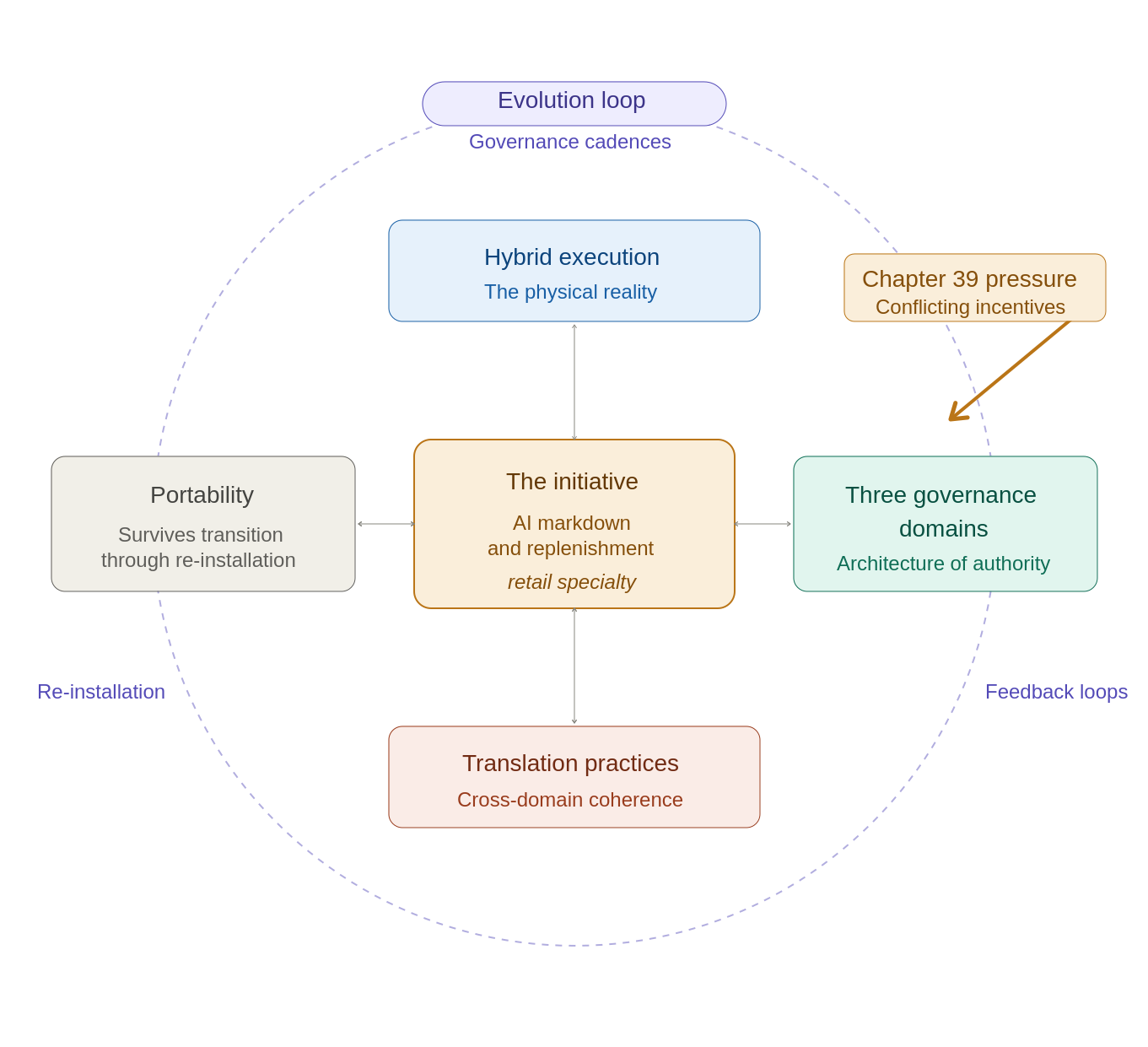
Figure I.1. One initiative, all surfaces. The four structural surfaces operate on the initiative simultaneously; the evolution loop is the temporal dimension through which they function; Chapter 39’s counter-pressure is a vector acting on the installed system.
What this example is, and what it is not
This example threads one initiative through the structural surfaces the book develops. It shows how the surfaces compose — how the execution surface defines what ownership and decision architecture have to address, how those define what the operating model has to sustain, how all of those shape the economics, how the economics and structure together shape what leadership alignment has to translate, and how the whole structure behaves under one real-world pressure.
It is not an exhaustive template. Every real initiative will encounter different versions of these surfaces with different specific pressures. The example is useful because it is specific; it is limited by the same specificity.
The reader who has worked through the book linearly will recognize every framework applied here. The reader who opens to this appendix cold will see the book’s full structure operating on a single concrete case. Both uses are intended.
What this example shows is not how to apply the framework. It shows that once an initiative crosses into hybrid execution, every surface the book develops becomes unavoidable — not as options a CTO might address but as structural realities that operate whether the CTO addresses them or not. The surfaces do not wait for attention. The initiative moves through them either way.