
Chapter 19: When the System Decides
Parts II and III built the governance infrastructure for the execution surface: who owns executors, how the ACG authorizes deployments, how the escalation surface is designed, how recalibration works, and how accountability is assigned across executor types and execution modes. That infrastructure exists to govern executors that are already on the surface.
This chapter addresses the decision moment before that infrastructure engages — the act by which an organization deliberately extends authority to a system rather than simply deploying one. That act is not the same as deployment. Most organizations deploy systems continuously. Very few have a distinct, documented process by which they grant a system the authority to decide, define the scope of that authority, and assign accountability for whether the grant was appropriate.
The absence of that distinct process is what separates an organization with automation from an organization with governed delegation. The governance infrastructure from Part III is necessary but not sufficient. It governs ongoing delegation. This chapter addresses the decision that initiates it — and the decision that ends it.
THE CORE IDEA
Governed delegation is a two-act structure. The first act is the authority grant: the deliberate organizational decision to extend authority to a system, at a defined execution mode, with a defined scope, and with a named person accepting accountability for whether the grant was appropriate. The second act is the authority withdrawal: the deliberate organizational decision to reduce or remove the authority a system holds, when conditions have changed enough that the original grant no longer reflects what the organization would authorize today.
Most organizations have neither act as an explicit process. They have deployment — the technical act of putting a system into production. Deployment is necessary but not sufficient for governed delegation. A deployed system has entered the execution surface. An authorized system has entered the execution surface with a deliberate grant of authority, documented accountability, and a defined process for review and withdrawal.
The distinction is invisible in normal operation. Both the deployed system and the authorized system produce outputs. Both affect customers, transactions, and operations. The distinction becomes visible when something goes wrong: the authorized system has an accountability trail — who granted what authority, under what conditions, with what scope — and the deployed system does not.
It also becomes visible when conditions change and withdrawal is required. An organization that has granted authority deliberately knows what authority it granted and can withdraw it specifically. An organization that deployed without governing the delegation does not know what authority the system holds, which makes withdrawal imprecise — typically either too broad (shutting down the system entirely) or too narrow (adjusting parameters without addressing the scope of authority the system was exercising).
Figure: Automation vs governed delegation across execution modes
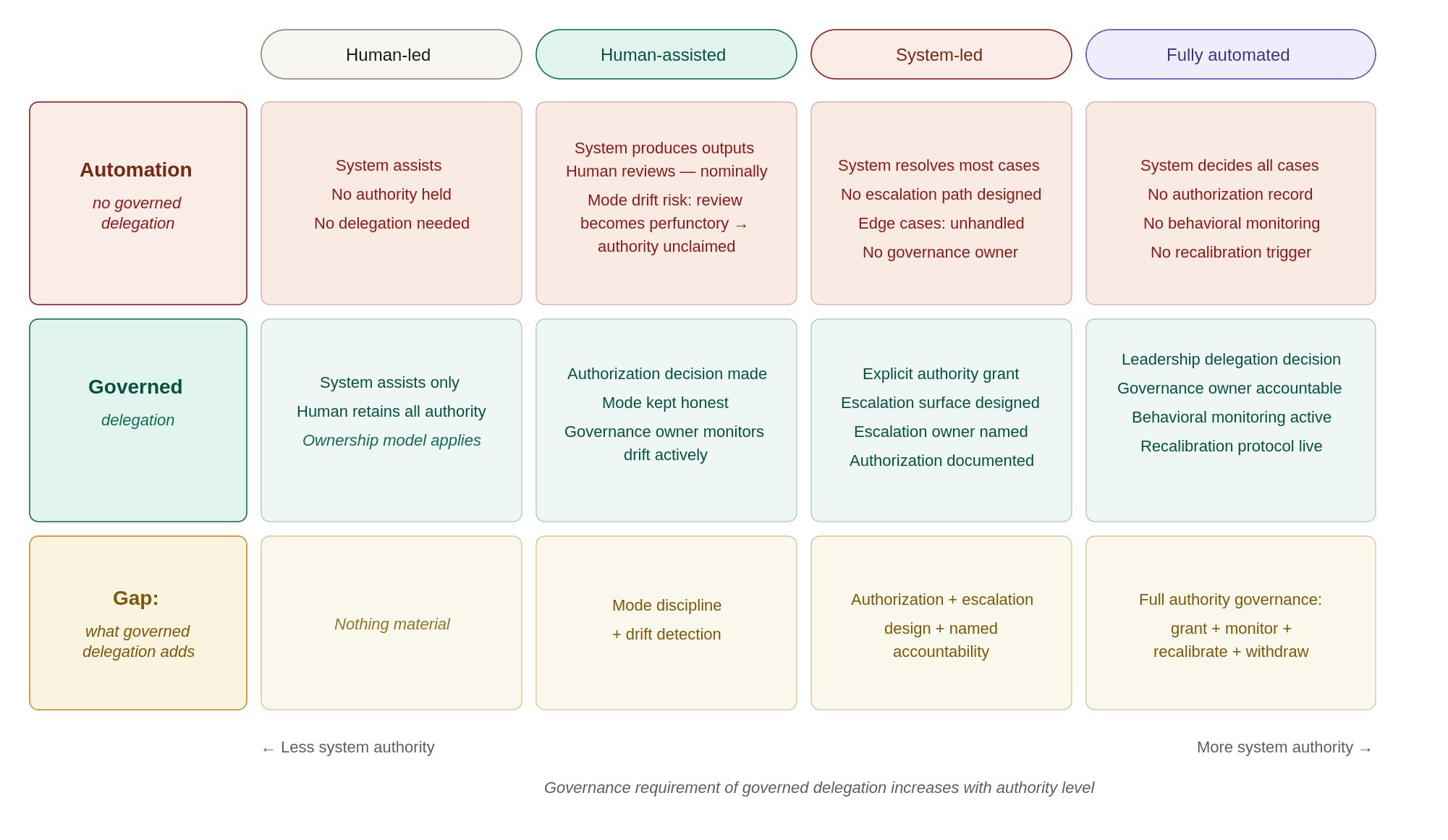
The gap between automation and governed delegation widens as execution mode moves right. In human-led execution the gap is negligible. In fully automated execution, governed delegation requires the full authority governance structure: grant, monitor, recalibrate, and withdraw.
WHAT AUTOMATION WITHOUT GOVERNED DELEGATION LOOKS LIKE
Two examples from organizations that have built consequential automation without the authority grant process that would make it governed delegation.
THE AUTHORITY GRANT DECISION
The authority grant is the organizational act that converts a deployed system into a governed delegate. It is distinct from the ACG deployment review established in Chapter 13 — the deployment review confirms governance fitness, but it does not itself constitute the authority grant. The authority grant is a leadership decision that accepts accountability for the scope of authority being extended.
The authority grant decision has four components that must be explicit before the decision is complete.
The scope definition. What class of decisions is this system being authorized to make? Not a technical description of what the system does, but an organizational description of what authority it holds. A fraud detection system authorized to flag transactions for review holds different authority from one authorized to decline transactions without review. The scope must be stated in terms of organizational consequence, not technical function.
The execution mode commitment. At what execution mode is this authorization being made? Human-assisted, system-led, or fully automated? The execution mode defines how far the authority extends into the system and what human oversight structure must exist alongside it. The mode commitment is part of the authorization — changing the mode is a new authorization decision, not a parameter adjustment.
The accountability assignment. Who is accepting accountability for the quality of this authorization? This is the governance owner from Part III — but at the moment of the authority grant, the governance owner is accepting a specific accountability: not just ongoing governance fitness, but responsibility for whether the scope and mode of the initial grant were appropriate. This accountability does not transfer or dilute over time.
The withdrawal conditions. What conditions would make this authorization no longer appropriate? Not a recalibration trigger — those are for parameter adjustments within the existing scope and mode. Withdrawal conditions are the circumstances under which the authority grant itself should be revisited: market changes that alter the risk profile, regulatory changes that affect the permissibility of automated authority in this domain, or performance patterns that suggest the scope was too broad for the system's actual reliability.
THE AUTHORITY WITHDRAWAL DECISION
Authority withdrawal is the mirror act of the authority grant. It is the deliberate organizational decision to reduce or remove the authority a system holds. It is not the same as taking a system offline — that is a technical act. Withdrawal is an organizational act: the explicit revision of the authority grant, with documentation of why the original scope or mode is no longer appropriate, and what authority the system holds after the revision.
Withdrawal is triggered in one of three ways. The first is a recalibration cascade: the Chapter 15 dual-ownership process concludes that the execution mode must change, which — as established in Chapter 17 — crosses into a delegation decision. The governance owner and purpose owner cannot complete this change within the recalibration process alone. The authority withdrawal decision must be made at leadership level, with the same accountability structure as the original grant.
The second trigger is a withdrawal condition from the original authority grant record. If the market has shifted in the way the original grant anticipated as a review trigger, or if a regulatory change has altered the permissibility of automated authority in this domain, the withdrawal condition has been met. The governance owner is responsible for recognizing this and initiating the withdrawal process.
The third trigger is a governance owner's or purpose owner's assessment that the original scope was too broad — that the system is exercising authority the organization would not grant today if it were making the decision fresh. This is the most demanding trigger, because it requires the governance owner to conclude that the authorization they accepted was wrong. It is also the most important: the governance model cannot self-correct if the people responsible for its fitness are not willing to surface this conclusion.
THE FAILURE MODE
The failure mode specific to this chapter is the organization that has governance infrastructure — ACG, ownership register, recalibration protocol, escalation design — but no authority grant record. The governance operates on the executor after deployment. The question of what authority the executor was authorized to hold was never asked before deployment.
This organization is not ungoverned in the Part III sense. Executors have owners. The ACG has reviewed deployments. The escalation surface exists. But the authority the executor exercises was never explicitly authorized. The governance owns the ongoing fitness of a delegation that was never deliberately made. If something goes wrong and the investigation asks who authorized this system to make this class of decision, the answer is: no one did. The system was deployed. The governance followed. The authorization never happened.
The second failure mode is the drifted authorization from the second example: a system that was properly authorized at a specific scope and mode, but whose authority has expanded through informal practice changes — threshold adjustments, review step degradation, scope creep in what the system processes — without triggering a new authorization decision. The governance record describes an executor that no longer exists in the form that was authorized. The actual authority the system exercises is larger than the authority on record.
Both failure modes share the same correction: the authority grant process must be a distinct act, separate from deployment, that explicitly states what authority is being granted, at what mode, with what accountability. And the authority withdrawal process must be triggered not just by system failure but by the governance conditions established at the time of the original grant.