
Appendix G - Operating Cadence Templates
Five templates — one per cadence activity introduced in Chapter 22. Each template defines what is reviewed, how it is structured, what inputs are required, what outputs are expected, and who owns the activity. Use these as standing reference tools: the weekly checklist governs every executor review session, the sprint and monthly templates provide embedded agenda blocks, the quarterly template is the primary governance session instrument, and the annual template drives the execution model review.
Figure: Operating cadence — 12-month timeline
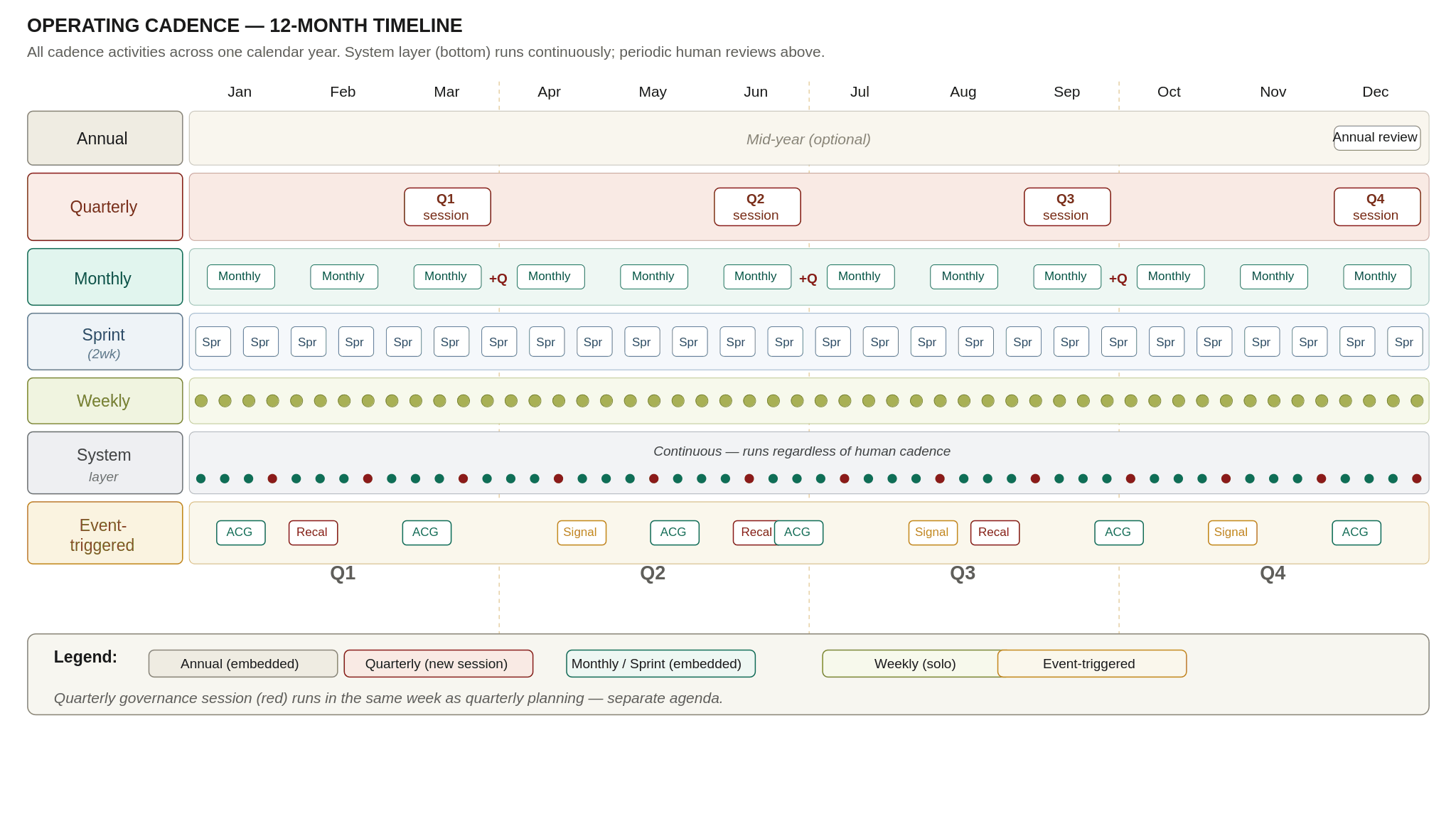
The full rhythm at a glance: 4 quarterly governance sessions (dedicated), 12 monthly reviews (embedded), ~26 sprints (embedded alignment check), 52 weekly monitoring cycles (solo), continuous system monitoring, and event-triggered reviews throughout. All five templates in this appendix map to this timeline.
Template 1 — Weekly Executor Monitoring
PRE-CHECK: CONFIRM MONITORING IS ACTIVE
| ☐ / ✓ | CONFIRM BEFORE PROCEEDING | IF NOT CONFIRMED |
|---|---|---|
| ☐ | Monitoring dashboards loading correctly for all assigned executors | Escalate to platform team immediately — do not proceed without monitoring data |
| ☐ | Alert routing confirmed active — alerts are reaching the correct destination | Log as monitoring failure in Appx F Log 3. Escalate to platform team same day |
| ☐ | Appendix F Log 3 open and ready to receive entries | — |
METRIC REVIEW — RUN FOR EACH EXECUTOR
| ☐ / ✓ | METRIC CHECK | IF FLAGGED |
|---|---|---|
| ☐ | Approval / resolution rate — compare to 90-day baseline. Flag if deviation > 5% | Initiate recalibration assessment within 30 days. Log signal date in Appx F Log 3 |
| ☐ | Denial / rejection rate — compare to 90-day baseline. Flag if deviation > 5% | Initiate recalibration assessment within 30 days. Log signal date in Appx F Log 3 |
| ☐ | Escalation rate (system-led executors) — is the volume within expected range? | If escalation volume has increased >20%, review escalation criteria. Log finding |
| ☐ | Demographic distribution (if applicable) — check against quarterly bias audit benchmarks | Flag for governance owner investigation. Do not wait for next quarterly review |
| ☐ | Edge case handling — have any cases resolved in unexpected ways this week? | Document specific case. Assess whether recalibration or escalation surface redesign needed |
| ☐ | Error / failure rate — any unhandled exceptions or system failures? | Escalate immediately if failure rate has increased. Do not defer to next review |
DECISION TREE — OUTCOME OF THIS SESSION
| FIELD | CONTENT / GUIDANCE |
|---|---|
| All metrics within range | Log 'No action required — [date]' in Appx F Log 3. No further steps. |
| One or more metrics flagged | Log signal in Appx F Log 3 with date, metric, and variance. Initiate recalibration assessment within 30 days. Inform purpose owner. |
| Monitoring infrastructure failure | Log in Appx F Log 3 as infrastructure failure. Escalate to platform team same day. Flag to CTO if not resolved within 48 hours. |
| Immediate escalation condition | Stop. Escalate to CTO immediately. Log in Appx F Log 3 with timestamp. Do not defer. |
Template 2 — Sprint Mode Alignment Check
FOUR STANDING QUESTIONS — ASK IN ORDER
| Q | QUESTION | IF YES — ACTION |
|---|---|---|
| Q1 | Is any workflow running in human-assisted mode that is ready for system-led? (Boundary well-understood, monitoring in place, escalation logic established) | Create governance backlog item: 'Mode transition assessment — [workflow name]'. Owner: governance owner. Due: within 2 sprints. |
| Q2 | Is any workflow running in system-led or fully automated mode showing behavioral drift that warrants attention? (Escalation rate up, output quality declining, purpose owner concern) | Create governance backlog item: 'Recalibration trigger review — [executor name]'. Owner: governance owner. Due: this sprint. |
| Q3 | Has any new automation, AI tool, or system integration been added to the team's execution surface this sprint that is not yet in the ownership register? | Create governance backlog item: 'Ownership registration — [executor name]'. Owner: governance owner. Due: this sprint. Must be complete before next sprint planning. |
| Q4 | Has any escalation from the system layer reached a team member this sprint that suggests the escalation surface needs redesign? | Create governance backlog item: 'Escalation surface review — [executor name]'. Owner: governance owner. Due: within 2 sprints. |
OUTPUT
| FIELD | CONTENT / GUIDANCE |
|---|---|
| Pass | All four questions answered No. Log 'Mode alignment — no flags — [sprint] — [date]' in team governance record. |
| Flagged items | Each Yes creates one governance backlog item. Owner, due date, and executor name are required fields before the session ends. Flagged items are not sprint commitments — they are tracked separately. |
| Escalation to CTO | If Q2 or Q3 identifies an executor in system-led or fully automated mode with no governance owner registered — escalate to CTO same day. Do not defer. |
Template 3 — Monthly Execution Surface Review
REQUIRED INPUTS — MUST BE AVAILABLE BEFORE SESSION
| FIELD | CONTENT / GUIDANCE |
|---|---|
| Ownership register | Current version — check for any unassigned executors added since last month |
| Appx F Log 1 | Authorization latency for the past 4 weeks — rolling average and any outliers |
| Appx F Log 3 | Recalibration activity since last monthly — signal-triggered events, flags, investigations initiated |
| Escalation log | Summary of escalations from system-led executors — volume, patterns, any unresolved cases |
| Monitoring alert summary | Alerts generated this month — how many, which executors, how many acknowledged vs unacknowledged |
20-MINUTE AGENDA
| TIME | AGENDA ITEM | OWNER / OUTPUT |
|---|---|---|
| 0–3 min | Ownership register status: any unassigned executors? Any ownership changes since last month? | ACG lead presents. CTO flags any that require immediate assignment. |
| 3–8 min | Authorization latency: current average vs target. Any deployments delayed or routed around the process? | ACG lead presents from Log 1. CTO notes trend vs prior month. |
| 8–13 min | Recalibration activity: signal-triggered reviews initiated, completed, or overdue. Any patterns across executor types or teams? | ACG lead presents from Log 3. CTO identifies any org-wide patterns. |
| 13–17 min | Escalation patterns: system-led escalation volume by executor. Any executor with anomalous escalation rate? | CTO presents. Governance owners of flagged executors attend if possible. |
| 17–20 min | Monitoring health: unacknowledged alerts, monitoring failures. Any executor running without active monitoring? | CTO presents. Any executor without monitoring is a P1 item — owner assigned before end of session. |
RAG STATUS — ASSIGN FOR EACH ITEM
| FIELD | CONTENT / GUIDANCE |
|---|---|
| Green | Within normal range. No action required beyond logging. |
| Amber | Outside normal range but not at threshold. Monitor closely. Governance owner notified. Review again at next monthly. |
| Red | Threshold breached or governance absent. Action required before next monthly. Owner named, deadline set, in-session. |
OUTPUT
| FIELD | CONTENT / GUIDANCE |
|---|---|
| Monthly status record | One-paragraph summary of overall execution surface health with RAG status for each item. Filed in ACG governance library. |
| Action items | Any Red or Amber items generate named actions with owners and deadlines. Tracked between monthly sessions by ACG lead. |
| Escalation to quarterly | Any item requiring model-level review or strategic decision is flagged for the quarterly governance session agenda. |
Template 4 — Quarterly Governance Session
PRE-SESSION PREP CHECKLIST — COMPLETE IN THE WEEK BEFORE
| ☐ / ✓ | PRE-SESSION PREP ITEM | IF NOT READY |
|---|---|---|
| ☐ | Appx F Log 1: Authorization latency quarterly summary prepared — avg, trend, outliers | If not available: ACG lead escalates to CTO. Session does not proceed without this input. |
| ☐ | Appx F Log 2: Delegation decision log reviewed — count, any absent decisions identified | If absent delegation decisions found: add to decision register before session. |
| ☐ | Appx F Log 3: Recalibration activity quarterly summary — count, signal vs cadence ratio, mode changes | If 0 recalibration activity: add investigation item to session agenda. |
| ☐ | Appx F Log 4: Model-level decision log reviewed — days since last decision, next review date status | If >12 months: add model-level decision as mandatory agenda item. |
| ☐ | Monthly session action items since last quarterly: status update on each | Any overdue items: owner presents status in-session. |
| ☐ | Ownership register: full current state, any unregistered executors identified | Unregistered executors: add to session decision register as P1 items. |
| ☐ | Permanent human-judgment boundary policies: last revision date for each domain | If any policy >12 months without review: add to session agenda. |
| ☐ | Board report draft prepared from quarterly summary template (Appx F) | CTO reviews draft before session. Finalized during session. |
90-MINUTE SESSION AGENDA
| TIME | AGENDA ITEM | OWNER / OUTPUT |
|---|---|---|
| 0–5 min | Opening: session context, agenda confirmation, decision register preview. Any items requiring addition to the agenda? | CTO chairs. |
| 5–20 min | Decision latency review: all four metrics from Appx F quarterly summary. Trend vs prior quarter. Signal interpretation for each. Board report status field updated. | ACG lead presents. CTO interprets signals. Status (In Range / Watch / Action Required) confirmed for each type. |
| 20–35 min | Recalibration health: executor-level review of recalibration activity. Any executor >12 months without review? Signal-triggered vs cadence-triggered ratio. Ownership model health. | ACG lead presents. Any dormant ownership pairs identified — owners notified in-session. |
| 35–50 min | Authorization and delegation review: ACG capacity vs deployment pace. Any absent delegation decisions. Scope drift identified. Authority grant records reviewed for accuracy. | ACG lead presents Log 1 and Log 2. CTO confirms any delegation decisions required. |
| 50–65 min | Decision register: work through each item requiring a decision this session. Authorization, delegation, recalibration cascades, policy revisions. Each item: decision made, owner named, record filed. | CTO decides. ACG lead records. Each decision documented before moving to next item. |
| 65–80 min | Model-level review: is the current execution model still appropriate? Distribution of modes, governance architecture fitness, permanent boundary policy status. Any strategic changes required? | CTO leads. Senior leadership input. Any model-level decisions made and logged in Appx F Log 4. |
| 80–90 min | Board report finalization: confirm all four latency metrics, status fields, accountable parties, correction statuses. CTO reviews draft. Any adjustments made. | CTO presents board report to attendees as rehearsal. ACG lead files completed report. |
DECISION REGISTER — MAINTAIN THROUGHOUT SESSION
| FIELD | CONTENT / GUIDANCE |
|---|---|
| Item | [Decision item description] |
| Decision type | Authorization / Delegation / Recalibration / Policy revision / Model-level |
| Decision made | [Decision text — one sentence] |
| Decision maker | [Named CTO or executive] |
| Owner | [Named person responsible for implementation] |
| Deadline | [Date by which implementation is complete] |
| Record reference | [Appx D, E, or F log reference for the filed record] |
SESSION OUTPUTS — ALL REQUIRED BEFORE SESSION CLOSE
| FIELD | CONTENT / GUIDANCE |
|---|---|
| Board report | Completed quarterly summary from Appx F. Filed in ACG governance library. Presented by CTO at next board session. |
| Decision register | All decisions from session documented with owners and deadlines. Filed in ACG governance library. |
| Action items | Any items not decided in-session — owner, deadline, and next review date confirmed before session closes. |
| Appx F Log 4 entry | If model-level decisions were made: new log entry filed before end of session. |
Template 5 — Annual Execution Model Review
FIVE REVIEW DOMAINS — ASSESS EACH
| TIME | AGENDA ITEM | OWNER / OUTPUT |
|---|---|---|
| Domain 1 | Execution surface coverage: does the ownership register cover every consequential executor? What percentage of the surface is governed vs partially governed vs ungoverned? Has the surface grown faster than the governance model? | Output: governance coverage percentage. Target: >95% of consequential executors governed. |
| Domain 2 | Mode distribution: is the current distribution of execution modes (human-led, human-assisted, system-led, fully automated) still correct? Are there workflows in the wrong mode — either not automated enough or automated beyond the governance model's capacity? | Output: mode distribution map. Any workflows requiring mode transition flagged as governance backlog items. |
| Domain 3 | Ownership model health: are dual-ownership relationships functioning? Are governance owners active and appropriately resourced? Has org change (reorganizations, departures, new teams) created ownership gaps? | Output: ownership health assessment. Any gaps create P1 action items. |
| Domain 4 | Governance architecture fitness: are the four decision types being made at the right levels? Is the ACG appropriately resourced for the organization's current scale? Are permanent human-judgment boundary policies current? | Output: governance architecture assessment. Any structural changes required escalated to a dedicated design session. |
| Domain 5 | Org design alignment: does the management structure account for the governance complexity of the execution surface (Chapter 8)? Are spans and layers calibrated for both the human layer and the system governance demands? | Output: org design flag list. Any changes required added to annual org design agenda. |
ASSESSMENT SCALE — ASSIGN FOR EACH DOMAIN
| FIELD | CONTENT / GUIDANCE |
|---|---|
| Current — no action | The execution model in this domain is correctly designed for the organization's current scale and strategy. |
| Needs revision | The execution model in this domain requires targeted adjustments. Governance backlog items created with owners and deadlines. |
| Needs redesign | The execution model in this domain is structurally misaligned. A dedicated design workstream is required. CTO owns. Timeline agreed before session closes. |
REQUIRED INPUTS
| FIELD | CONTENT / GUIDANCE |
|---|---|
| Full ownership register | Current state — all executors, all owners, governance status for each |
| Mode distribution summary | Count of executors by execution mode across the organization |
| Four quarterly governance session reports | The past year's quarterly summaries from Appx F — latency trends, decision register, model-level log |
| Permanent human-judgment boundary policies | All domain-level PHJB policies — last revision date for each |
| Org chart current state | Management layers, spans, governance accountability paths |
OUTPUT
| FIELD | CONTENT / GUIDANCE |
|---|---|
| Annual execution model assessment | One-page summary: assessment for each of the five domains, with status (Current / Needs revision / Needs redesign). Filed in ACG governance library. |
| Governance backlog items | All 'Needs revision' items: named owner, deadline, and next review date. |
| Design workstreams | All 'Needs redesign' items: CTO ownership confirmed, timeline agreed, first milestone set. |
| Appx F Log 4 entry | Annual review constitutes a model-level decision. Log entry filed before session closes. |